
The following testimonials have been written by members who have benefitted from our Union and who want to see its protections expanded and improved in our next contract. Thank you to those members who have shared their stories with us!
Read on to hear from working parents, survivors of harassment and/or discrimination, disabled students, and others from our diverse membership body about why we NEED to win a more equitable contract! (Some have been edited for clarity or to reduce the amount of potentially identifying information.)
WE NEED FAMILY AND PARENTAL LEAVE!
“Because I am not eligible for paid family and medical leave as a PhD student, I went back to my job as a teaching fellow just five weeks after my son was born. If I’d wanted to take more time off I wouldn’t have gotten any financial support for that period. The only reason I got even that much time at home was because my son was born at the very beginning of winter break. I am lucky that most of my work can be done from home on a flexible schedule, and that my program leadership is very supportive and understanding, but even with their support I don’t know what would have happened if I’d had a baby in the middle of a semester. Better family leave protections are even mor important now that grant funding…is harder to come by. No one should have to rely on having a baby during winter break to have time at home with a newborn without worrying about losing out on months of income.”
—Jessica Harvey, G3 in Social Sciences
“Giving birth to a baby means having to give up on money for the term or teaching out of the hospital. This is discrimination against women with children – it is about time to get at least a semester off if you have a child! How come you have to teach the week your baby is born or receive no money at all?”
— Anonymous student worker
“I started my PhD three months after my child was born. My family and I moved overseas so I could do my PhD. The most difficult part of my PhD so far has been the dealing with the lack of childcare or financial support for childcare, because even when my partner is willing to take on most of the caring for our newborn that translates to less time [for them] to work and earn a second income… We solely depend on what Harvard pays me, which is barely enough to pay for a small 2-bedroom unit in Harvard Housing… Being a parent and a PhD student and international is nothing new, much less uncommon… But the stress of not knowing if your finances will be enough to pay rent AND pay groceries AND transportation AND medical insurance for the whole family is just too much. How is it possible that the most prestigious university in the world and probably even the richest cannot cover these basic needs? If the university included childcare, housing, and insurance for all dependents, I would be able to concentrate on what I’m here for: my research, and not taking every little job I can get to make ends meet…”
— N, G2
PROTECT WORKERS FROM HARRASSMENT!
“I was physically assaulted by my advisor, which created a hostile work environment and prompted me to leave the lab. Even though both my advisor and I were affiliated with Harvard, I could not access the majority of Harvard resources because the incident happened on a hospital campus. Following this incident, my advisor continued to act in student-facing roles including serving on admissions and as a first-year advisor for other students in my program. This experience has set a negative precedent for other similar situations in the future, that student workers on hospital campuses cannot receive support from Harvard and that there are no repercussions for hostile behavior by appointed Harvard faculty.”
–Anonymous student worker
STUDENTS SHOULD NOT HAVE TO TAKE FULL COURSE LOADS WHEN SICK OR DISABLED!
“After a diagnosis of [a serious chronic condition], my doctor wrote a letter to the DAO specifically requesting a reduced-course load for the Fall semester to allow me the chance to figure out treatments and begin to heal. The DAO took weeks to process my accommodation request and then on the second day of the term, rejected it. This left me in a panic trying to figure out if a full course load was feasible with my health. After the rejection, I spoke with many other Harvard offices, who told me that there was an unwritten rule of not allowing reduced course loads for doctoral students and therefore there was no hope of appealing… I was forced to take on a full course load and at the beginning of November realized that doing so had made my medical condition significantly worse. I have now had to declare a full medical leave (during which Harvard does not pay for health insurance) and am in a worse position health-wise than I was in September.”
–G2 in Liberal Arts (Humanities/Social Sciences/HDS)
WE MUST BE ABLE TO HOLD FACULTY ACCOUNTABLE AND HOLD THEM TO REASONABLE STANDARDS!
“There’s a tenured prof. at my department with whom there’s been some issues about how he’s using his power in [ways that put students] in the uncomfortable position of wanting to call attention to his behavior, but at the same time fearing that the prof. won’t have any consequences and instead take it [out on] the student who made the call. One semester, after it had started, he decided that his 2-hr/week seminar would become a 3-hr/week seminar… He wanted to add an “optional” 2hr/week meeting on another day. He gave a syllabus until the middle of the semester, making it difficult to plan ahead of time the activities for the semester… and the professor was never clear about the expectations he had for the students… After I reported these events [and others] with my advisor and the DGS at that time –who understood this behavior was not proper– the professor continued as he was. This leads to the second experience I had with him. This second experience regards credit transfer from my master’s study. Although I provided the documentation that I was asked for, this professor asked for extra documentation and was hesitant on approving credit transfer for my case. I learned that other faculty members from my department spoke out in the department meetings about what was going on. We need more protections when it comes to faculty members, particularly tenured members, who [use] their power to bully students navigating the system of the university.“
–Member, Liberal Arts (Humanities and Social Sciences)
“I suffered from extremely poor working conditions in the lab I initially joined when I enrolled in the Harvard SEAS PhD program. By the middle of my second year, I felt that it was necessary to leave that lab in order to make progress towards my degree… Without an advisor, I essentially had to apply for my PhD all over again… I was able to receive my stipend in exchange for teaching over the summer and in the subsequent semester, but there was no support system in place for helping me get back on my feet and make progress towards the PhD. During this time, I met with the director of graduate studies, the program coordinators, SEAS inTouch, peer mentors, the Students Affairs office, and professors in my program. All of them had basically the same thing to say: “Sorry, but this is an unprecedented situation and there’s not much we can do. Good luck finding an advisor!” I met with every SEAS professor who does research in my area, and eventually scored an “internship” trial period with one. At the end of my unfunded semester-long “internship”, I was offered the opportunity to continue working with the lab — still unfunded, this time with no stipend (my semester+summer was up!), and with continued ambiguity about whether I would actually have an advisor. At this point I had exhausted my resources; I felt unheard, unseen, and abandoned. I rejected that advisor’s offer and dropped out of the program, and academia, altogether. My experience is just one example of Harvard’s profound negligence towards graduate student workers who leave their labs due to negligence, bullying, or other untenable working conditions created by advisors. Advisors need to be held accountable for the working conditions in their labs, and student workers who leave labs due to poor working conditions need structured support from the program to ensure they can continue to make progress towards their degrees. Otherwise, they may just [waste] away in the SEC for 8 months before abandoning their PhD ambitions and dropping out. I speak from experience.”
— Anonymous former student worker in School of Engineering and Applied Sciences
“Harvard’s administration tells my non-citizen peers to trust that it cares about them and that it is standing up for them on the national stage––but Harvard’s unwilling to put this supposed commitment in writing. In fact, as of March 2026, Harvard has yet to respond to the non-citizen worker protections proposal the union made last June! I’m ready to strike for discrimination protections, fair compensation, and, above all, the non-citizen peers that help make this place my home.”
— Marley, PhD Candidate in Philosophy
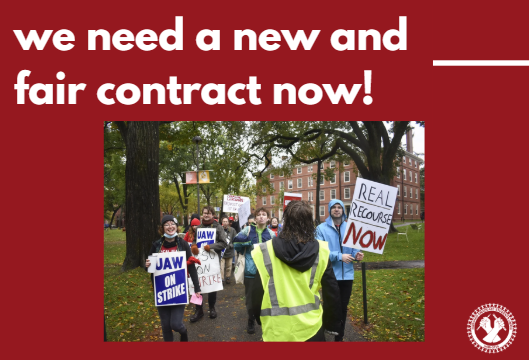
“Wage equality and real recourse are absolute non-negotiables. The cost of living is constantly rising, and it is crucial that all graduate students receive the money we deserve and need to survive. Harvard has also consistently failed to protect its students from harassment and discrimination, meaning that we need real recourse, or third-party arbitration on harassment and discrimination cases, to ensure our safety. We are fighting for basic rights—money to live and physical and emotional safety at work—and if Harvard continues to deny us this common decency, then we show Harvard what we’re worth!”
— Edan, PhD Candidate in History
PUT A STOP TO THE “G4 CLIFF:” PAY TFs FAIRLY THROUGHOUT THEIR TIME AT HARVARD
“As a G4, I have priority for TF positions in my department, as well as access to summer funding and the top-up. I am a single adult who lives with a roommate in an apartment priced below market value in Cambridge, and already it is hard to make ends meet. It is difficult to budget for necessities every month, especially with the climbing cost of living… As a graduate student at Harvard, with our current dental insurance package, I have skipped checkups and procedures due to fear of incurring healthcare costs that would require me to go into debt. And even though my apartment is not conducive to my health or wellbeing (poor insulation, a dangerously deteriorating foundation, excessive noise, poor plumbing, and a neglectful landlord), I have not moved, as the up-front costs of renting in Cambridge would also require me to use up my savings and/or go into significant personal debt. Since starting this program, I have not been able to meaningfully add to my long-term savings.
“Next year as a G5, my financial situation will worsen significantly. Because of the structure of TF pay, I would have to work more than double the number of sections to even match my current compensation. This would undoubtedly force me to all but stop working on my dissertation, which would only further delay my advancement and eventual graduation. My department’s average year-to-degree is far higher than 5 years… In order to apply for and accept DCF next fall, I’d have to be 3 years ahead of the average pace of my program, which I have not found possible. Graduate students in my department often pursue funding from fellowships to help patch the difference. Even on a normal year, this is a risk, and few students are actually able to compensate for their cut wages with fellowship funding. I have loved my time as a TF. It is interesting and fulfilling work. But I do not see a reason for my workload to double while my pay stays the same – in practice, for equal work, my wages will be halved. In this testimony, I would have liked to explain what my options are for next year…, facing what is known amongst my peers as the “G4 cliff.” The truth is I don’t know what I’m going to do. In all likelihood, I will scramble to get as many TF positions as possible, working well over 40 hours a week as a TF, not counting research or dissertation work… I’m not sure how my new paystubs would even qualify me to rent a room in this state– that’s something I’ll have to figure out. My research will suffer, and my dissertation will stall. Whatever savings I’ve managed to build up before starting this program will likely be gone by the time I finish it.”
—Anonymous member in Committee for the Study of Religion (CSR)
WE NEED PAY EQUITY!
“The amount of stipend I receive will drop off radically on my fifth year. To make matters worse, I am an international student and can only work for limited hours on campus. This severely limits my capacity to support myself financially and disrupts my research.”
—Anonymous, Humanities and HDS
“As a G6 worker in the humanities living in Camberville under Harvard’s current compensation scheme, I know we need pay-equity and cost-of-living adjustments NOW. I’m frustrated for myself, but I’m even more concerned about my friends, especially non-citizen workers who are legally barred from working outside the University, being forced to suffer a similar pay cut after their G3 and G4 years. Livable wages and a safe workplace is the bare minimum that graduate student workers deserve. Harvard isn’t meeting it and that is exactly why I am ready to strike!”
— Seton, Humanities and Social Sciences
ACADEMIC FREEDOM AND PROTECTIONS AGAINST RETALIATION!
“At the School of Public Health, I’ve seen researchers punished for speaking up for human rights, funding cuts used to justify layoffs and mistreatment, and hundreds of grad workers stripped of their right to union representation without warning. Recent times have made it clear that workers’ rights and protections exist only at Harvard’s convenience. As much as I’m ready to strike for a livable wage (especially for my colleagues who make $26k a year), I’m also ready to strike to help secure enforceable protections for things like appointment security, academic freedom, and access to real avenues of recourse for cases of harassment, discrimination, bullying, and retaliation.”
–Laura, G4 in Population Health Sciences
WE NEED BETTER HEALTHCARE BENEFITS!
“I rely on our union benefits & protections to get by. When we were under a contract, I didn’t hesitate to go to the ER when I needed to, because I knew that my $100 copay would likely be reimbursed from the healthcare fund. Since our contract expired in July, I’ve been putting things off like getting new glasses and refilling prescriptions. Groceries are more expensive than ever and my landlord wants to raise my rent again.”
— Zoë, PhD Candidate in Biological & Biomedical Sciences
