
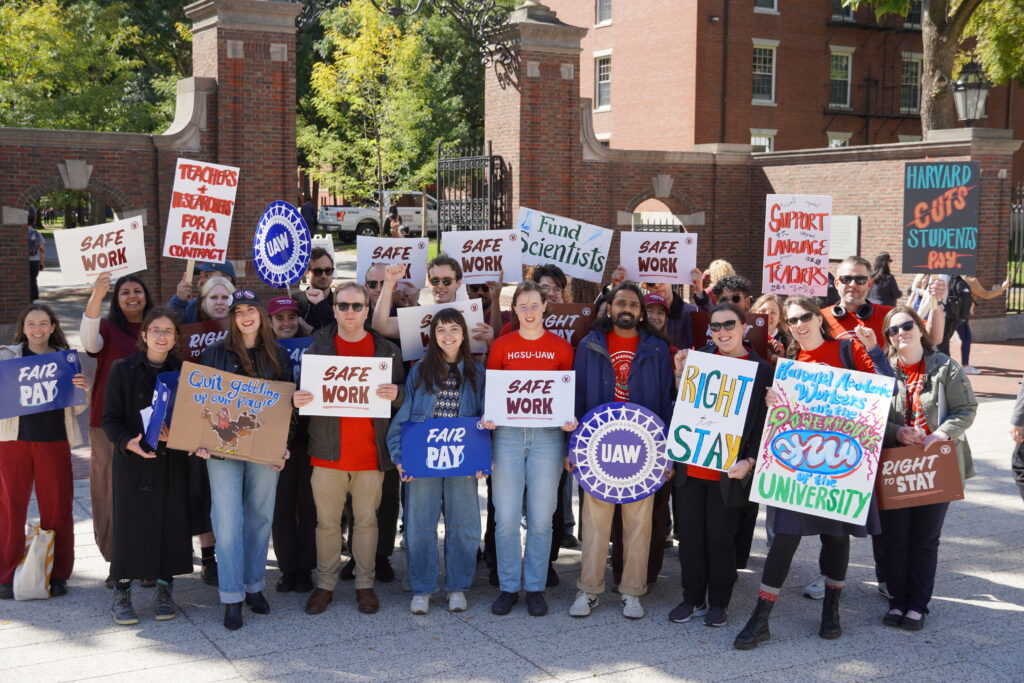
WHY STRIKE? HGSU has been bargaining for a new contract since February 2025. Over the last 15 months, the Harvard administration has refused to negotiate on several key issues, including: real recourse against harassment, discrimination, and bullying; cost of living adjustments; and noncitizen worker protections. Just one day after our contract expiration, on 6/30/2025, the Harvard administration unilaterally—and in violation of our collective bargaining agreement—carved out almost 1,000 student workers from their union eligibility. Our membership overwhelmingly agreed (95.8% “Yes”, 80% turnout) that a strike is necessary to push the University toward a fair contract that protects its workers.
Jump to info for:
For Student Workers (RAs, TFs, and CAs)
FAQ
Picket lines are essentially protests that make our presence on campus visible. There will be picket lines in front of buildings on campus, where workers will be marching and make our voices heard.
Generally, workers will be picketing from 8:30-4:30 Monday through Friday on Cambridge and on the Longwood campus. Members will lead teach-ins on contract issues, host lunches, and coordinate other community care events that help boost morale and support workers while we are on strike. Read the following for more info on how to be in solidarity without strikebreaking.
Anyone is welcome to join us on the picket lines and for our community events! We would also love if students emailed their professors urging them not to cross the picket lines when holding classes or scabbing our labor. For a full view of our weekly strike schedule, click here or find us on Instagram.
We have been bargaining since February 2025. Since then, we have reached agreement on nine (9) contract articles, which have won PhD students fully covered dental premiums, retaliation protections, funding transparency, private workspaces, and more. We won these agreements because of our historic, 40-day strike in the spring. Before our strike threat, we only had agreement on one (1) article. After the events of our 40 day spring strike, this rose to 9 articles by the end of the summer (see all bargaining updates here). We all know what a strike costs. Our spring strike demanded real sacrifice from all of us, and we made it for each other. We also know that our strike power is the only thing that has moved Harvard at the table over the past 19 months.
A strike is no one’s first option, and we will do whatever we can to avoid a strike. However, Harvard does not respond to our other actions – they ignore reasoned arguments at the table, testimonies, petitions, rallies, phone-zaps, and other forms of pressure we have tried to exert. They have, however, responded to our strike power:
- We reached agreement on eight (8) of our nine (9) settled articles after our spring strike.
- Our last contract in 2021 was settled after a threat of a second strike.
Harvard has made our options clear: we must prepare to strike again for a contract that is not worse than our previous.
You are not obligated to strike if you voted “Yes.” However, a strike is only effective through mass participation. What we win in our contract depends upon our unity in a strike, should one be called. You are also welcome to participate in the strike if you did not participate in the strike authorization vote!
There are two elements of a strike: withholding labor and picketing.
- Withholding labor means that we would cease doing the labor protected by our contract. For graduate students in teaching roles (TFs, CAs), striking means that not doing any of our teaching-related work, including holding sections, attending teaching meetings, hosting office hours, or grading assignments. Similarly, graduate students employed in research positions (RAs) on a part-time or hourly basis will not perform any of their research work. Striking full-time student researchers will, however, be able to perform necessary maintenance work and other activities necessary to safeguard ongoing experiments and their academic progress.
- Picketing makes the absence of our labor visible to the broader University community and lets them know what we are fighting for. Check out this video of our very first strike in 2019. This strike won us our first contract, which included guaranteed sick leave, guaranteed raises, an independent process to adjudicate workplace disputes, and nearly $1 million to support childcare and healthcare expenses.
We know that the lines between your academic work (which you should not strike from) and the labor you do for the University can be blurry. To address this, we have developed specific strike guides/worksheets to help support workers in understanding what work they should withhold. Contact your stewards directly with any questions and to develop specific strike plans that make sense for you!
The strike deadline we have communicated to the University is 11:59pm October 27, 2026. This means that, barring significant movement from the administration on our contract, we will begin striking on October 28, 2026.
Ending a strike is a democratic decision that will occur when members feel we have reached a sufficient “tentative agreement” (TA) on our contract. Members will then vote to ratify this TA, and if that vote passes, that TA will become our contract. As above, we will make this decision in membership meetings. Come to meetings!
Strike duties are varied and will include being outside on pickets, drafting communications about the strike, creating strike materials, leading teach-ins for fellow workers and community members, and many more. Members can check their email or contact their stewards to learn more about what’s involved!
Anyone can join our picket! Simply show up between 8.30 AM and 4.30 PM at the picket check-in locations – Science Center Plaza in Cambridge and Countway Plaza / Kresge Courtyard in Longwood. Check your emails for any updates. Organizers and strike captains will be on-site during in-person picketing where you will check in and out after each shift. You must do this to receive strike pay. You can also sign up for virtual pickets if you are remote or have accessibility needs.
Members can also sign up for other teams and to be strike captains. These are all important roles that supports a variety of coordination tasks and helps maintain our communal safety while we’re on the picket lines.
It is illegal for faculty to retaliate against a striking student worker. Faculty are legally barred from trying to fire striking students; punishing striking students by refusing to hire them in the future; forcing students to work overtime after the strike; engaging in verbal intimidation, threats, or bullying; attempting to hurt a striking student’s professional reputation, including in letters of recommendation; or pursuing any other formal or informal disciplinary measures.
The University has claimed that they might view a potential strike by HGSU “intermittent.” In no uncertain terms: the University’s statement is false, is not supported by labor law, and is a scare tactic designed to prevent student workers from exercising their legal right to collective action. Three Harvard Law School professors agree that the “University is wrong to characterize the HGSU strikes as intermittent.”
The National Labor Relations Board (NLRB) has made it abundantly clear that employees are not unprotected if they engage in more than one work stoppage, even over the same issues. In Walmart Stores, Inc., 368 NLRB No. 24 (2019), the NLRB defined an intermittent strike as follows: an “intermittent strike unprotected by the Act is a strike pursuant to ‘a plan to strike, return to work, and strike again.’” Any suggestion that HGSU has ever made such a plan is patently false.
The NLRB then continued:”We are certainly not suggesting that employees who go on strike cannot go on strike again based on even the same demands as the first. Deciding later that circumstances warrant going on another strike is fundamentally different than planning a strategy to strike, return to work, and strike again for a more damaging effect with less risk.”
Two strikes, separated by at least 4 months, authorized by separate membership-wide votes, and called at different stages in the bargaining process clearly do not constitute intermittent striking.
The University’s messaging continues its pattern of unlawfully attempting to stop our union from fighting for the contract we so desperately need.
We will not accept these intimidation tactics. We have sent a response to the University making it clear that the University’s messaging has no basis in law, and we will continue to fight against this baseless posturing. Ultimately, our safety as workers is ensured by our commitment to collective action and our strength in numbers. Together we can, and will, win safe work, fair pay, and the right to stay for all student workers at Harvard.
The Harvard administration is not required to cut the pay of any graduate worker engaging in their legal right to strike. However, they may choose to do so to intimidate or coerce a worker to continue working. Given this risk, to support our right to strike, our parent union, the United Auto Workers (UAW), has created a Strike Fund that supports striking workers and that is funded by our dues and the dues of other UAW members. The Strike Fund provides $500/week to workers on strike, as strike pay. Strike pay is taxable. You must be an in-unit, dues-paying member to be eligible for strike pay; sign a membership card here!
Note: Strike pay will only be made available if HGSU is on strike for more than a week. To be eligible to recieve strike pay, workers must perform strike duties for at least 8h/wk for hourly workers and 15h/wk for salaried workers. Both citizen and non-citizen student workers can legally receive strike pay. If you were carved out after June 30, 2025, you will need to sign up to pay dues through the union to be eligible for strike pay – you can sign up here.
Community allies also typically create Hardship Funds which can help provide support to striking workers if strike pay does not adequately cover your needs.
HGSU allies in Boston’s DSA Labor Working Group are hosting a hardship fund to support HGSU’s most vulnerable workers, such as those with dependents. If you would like to donate, click here!
Members who experience particular financial hardship during the strike can use this form to request support. Since funds are limited, we cannot guarantee that every need is met, however, with the help of our allies and fund hosts, we’ll do our best!
If you have not heard back by email or text within 48 hours, reach out to our financial secretary, Beau Schaeffer, at [email protected].
Yes! We have a community guide specifically for non-citizen and international students, which you can view here.
The right to strike is protected by the National Labor Relations Act (NLRA), which allows unions to engage in concerted activities to bargain collectively. However, in order to be protected by this right, you must strike fully from your job and cannot pick and choose what you strike from (known as “partial striking”).
The NLRA does not differentiate between citizens and non-citizens. The right to strike applies equally to U.S. citizens and noncitizens, meaning that you have the same rights and protections for striking as domestic workers (as well as to join a union, vote in union elections, and engage in other union activities). Further, U.S. Citizenship and Immigration Services (USCIS) cannot ask you questions about your union membership or participation in lawful union activity. Nor can they use such information in determining the outcome of your immigration/visa application. Out of tens of thousands of international graduate students, postdocs, and researchers that are part of UAW, there has never been any reported instances of participation in a union negatively impacting visa or permanent residency applications, including during our first strike which occurred under the first Trump administration.
We understand that under the current Trump administration, workers have concerns that legal protections don’t matter. We have created guidance for international workers who may have questions about how best to participate in this strike – please email [email protected] for this guide and to talk through your specific situation.
The UAW’s (our parent union) position is that carved out workers are workers, and as such, they have the legal right to strike. In fact, we anticipate the University will lose its frivolous attempts to delay a ruling in our favor on this issue. Workers in carved-out positions participated in our labor strikes in both 2019 and 2021 without any repercussions. As with all striking research assistants, the strike should not impact your academic progress, which will limit Harvard’s ability to retaliate as they do not consider carved out workers employees (contact your stewards for the RA strike guide, which has more details).
Ultimately, our power and protection comes from our numbers. The more carved out workers that strike, the harder it is for Harvard to retaliate, and the easier it is for us to win a new contract – which would pave an easier legal path for us to fight our carved-out status.
No one wants to go on strike; a strike is our last resort to securing a fair contract. The possibility of striking, and its impact on undergraduate education is extremely powerful, and is one of our primary levers of power. One of the major turning points of the HUDS strike in 2016 was when undergrads’ well-being was impacted, and parents started calling the university.
Historically, undergraduates have been very supportive of our cause since they know better than anyone that Harvard works because we do. And ultimately, the provisions we’re fighting for in our contract will help us be better teachers. Healthy, protected, and financially stable student workers can devote more time and energy to teaching. It’s precisely because we care about our students that we are devoted to securing the contract protections that will allow us to be the best teachers we can be.
The most important thing is to be visible in the strike. Your PI/supervisor may ask about your strike status for reporting purposes, both to the administration and potentially for effort-reporting purposes: say yes, you’re on strike! You should withhold your paid labor, which is 20 hours a week, but not any labor related to your personal academic work. We understand that the difference can be confusing, so we have made guides – contact your stewards for the RA strike guide to get more details!
If you have additional questions, please contact [email protected]
Whether you are a G1 or G2 taking courses or an upper-G on a research fellowships, you can still participate in strike and picketing activities! The most important part of striking is making our labor more visible to the University administration as we continue to fight for a fair contract for all student workers on campus.
You should not stop doing things that are for your own research projects. When you are not working on your dissertation research or attending seminars, join us on the picket lines! If you have to be on campus, wear your Union button, beanie, or shirt. If you’re already working remotely from campus, there are lots of asynchronous tasks that we will need help doing: communications, processing membership data, organizing community events, making signs, and other tasks that support the Union in the event of a strike. Contact your stewards if you are interested in getting more plugged in!
For Faculty
Email Updates
Dear Members of the Harvard Faculty,
We want to thank you immensely for your support during our now five-week-long strike. We know that this has been a difficult time for you and our students. It has meant so much to us that we continue to receive messages of support and see acts of solidarity even as the University administration continually tries to artificially pit our needs for decent working conditions against your own.
We have now passed the final deadline for grades to be turned in, and we are so appreciative of those who are not submitting their grades in solidarity with us and our fight for grievability of harassment/discrimination, protections from ICE, pay parity paid medical leave and other reasonable benefits common at peer institutions. We also ask that you continue not to turn in grades that would fall under the appointment of a striking student worker, and that you continue to report to the union any efforts from administration to replace our labor and yours by hiring outside graders. Such practices are an insult to the nature of teaching labor, as they conscript unprepared outside actors in the intellectually and emotionally rich work of providing valuable feedback for students’ learning, while keeping those who know the classes, projects, and students from fulfilling the work they want to return to under a fair contract.
We know that many of you may be nervous, as we reach the end of teaching appointments, that a back to work plan that would enable us to complete grading will not be reached with the University. It is our utmost hope that this can still be reached, but would require swift and meaningful movement on the University’s part.
We want to be clear that we have struck with the hope and intention of completing this work once a fair contract is won, and have expressed many times at the bargaining table our eagerness to go back to work. To our disappointment, the administration has met these urgent and time-sensitive concerns with practiced apathy. Two sessions ago they proposed gutting every benefit fund from our contract, things which we depend on to live and work with dignity. Last session they proposed a package that offered meaningless changes to small articles, proposed a new “housekeeping” article over a year into this process and said “take these in exchange for dropping all your proposals and accepting all of ours.” It is now clear that their strategy has been to wait us out, with no sense of urgency or concern for the potential consequences at the end of the semester. Yesterday at bargaining was the first time the University’s bargaining team has acknowledged at the table that we are on strike. However, they also began the session by telling us they have no intention of meeting the core needs of our workers. This strategy of signaling that we do not matter, that they can afford to ignore us indefinitely, has necessitated what is now the longest strike in this union’s history, and placed you in the untenable position of being pressured to take on our work – sometimes under coercive threats to your own careers.
Lastly, we have become aware of a series of emails that have been sent to faculty at several schools, asking that faculty take on the University’s role of threatening consequences for students that do not self-report their status as striking. These emails play on faculty concern for their students by warning that student workers might need to pay back wages, or face disciplinary action, if they do not self-report. Let us be crystal clear: it is unlawful for the university to unilaterally change the conditions of our work such that reporting hours is required, which is what this request to report entails, or enact any form of discipline in retaliation for failure to report. The fact that the administration sent these emails to faculty, but has not sent similar threats of discipline to student workers directly, shows their awareness of the legal riskiness of this move. They are attempting to conscript you into carrying out their union-busting efforts, through manipulative appeals to student welfare. Furthermore, this order seemingly contradicts the University’s own guidance (full here) on the specific parameters by which faculty are legally allowed to communicate to their student workers about the strike. Finally, we ask you to reject these calls to ask workers to self-report because creating any list of striking workers, particularly any which include non-citizen workers, opens our workers up to significant risk if the Trump administration were to, for example, subpoena such information to further its attacks on the University.
We condemn these highly inappropriate attempts to pit you against your students in this labor dispute, and we are very sorry that the university’s unwillingness to negotiate comes at your expense. We are working very hard to reach an agreement and have made significant movement, but it simply isn’t being met with any sort of reasonable response from Harvard’s negotiation team or upper administration.
This has been a difficult time for all of us. We sincerely hope that no further disruptions beyond this semester will be necessary, as the damage that the withdrawal of our labor has inflicted upon the whole University community is extensive. However, whether further disruptions occur is entirely in the hands of University administrators because we need the protections we are asking for. They are betting that we will give up, which shows their lack of understanding of how essential the issues we are fighting for are to us.
In solidarity,
Denish K Jaswal
Ph.D Candidate and Department Writing Fellow, Harvard University Philosophy Department
President, HGSU-UAW Local 5118
Evan Lemire
Ph.D Candidate, Harvard T. H. Chan School of Public Health
Vice President, HGSU-UAW Local 5118
Dear Members of the Harvard Faculty,
Thank you to all those who attended the faculty town hall yesterday and for your continued engagement with us. We deeply appreciate your support and solidarity, and are writing with a few clarifications about our guidance for faculty during this period of finals/grading.
Guidance for Finals and Grading Period
The bottom line of our request is: please do not absorb, reassign, or hire out the work of striking TFs, CAs or RAs. When struck labor gets performed anyway, the disruption is reduced, prolonging the dispute. We do not want to continue a strike through commencement or into the fall semester, but that may happen if the University does not make movement on our core issues. The fastest path to resuming normal teaching activities is for the University to bargain fairly with us.
To support our strike, we request that you:
- Do not grade any assignments or submit any grades for classes that HGSU instructors and graders are usually responsible for, including grades for seniors. This means that you should not rely on pre-strike assignments to provide final grades or otherwise give students all As, temporary SATs, or other forms of passing grades. Our ask is that you not turn in grades at all if HGSU workers would normally facilitate finals or grade final papers for students until the resolution of the strike.
We understand that this guidance may raise concerns that graduating seniors in particular will not be able to graduate. We find it unlikely that Harvard administration will, through no fault of the students, fail to find a way for seniors to be able to graduate – not doing so would create a significant crisis for Harvard leadership. By threatening not to graduate seniors and intimidating faculty into working beyond what is typically expected, Harvard administration is strike-breaking. We are not aware of another campus where graduating seniors were punished for a university administration’s opposition to settling a fair contract. We ask that you not give into these threats, and we appreciate the dozens of course heads who have already committed to not submit any grades for their course until the resolution of the strike.
You may receive threatening emails from the administration about turning in your grades. We ask that you resist these emails as much as possible – if helpful, you can consult some of our sample language here (under #6). If you would like more specific guidance or support, please reply to this email or fill out our form here.
- Write upward. Email your chair, dean, and administrators explaining that you cannot complete grading without your teaching team and that the University needs to offer HGSU more bargaining sessions to resolve this. This document includes a template you can use to urge administrators to bargain more frequently with us.
- Do not conduct sections, labs, or office hours normally taught by striking workers, and do not hire replacements.
- Do not compile or share any lists of strikers.
- Be transparent with students about why grading or course completion may be delayed. Encourage them to reach out to the administration to express their concerns, as it is the administration who has the ability to end this strike and prevent disruptions to their grades.
We recognize that these requests are significant, and we do not make them lightly. While this is our guidance, it is better to do some of the above than none of it. Undermining a strike for improving working (and learning) conditions will likely prolong it, and supporting a strike helps to shorten it.
Bargaining Updates and Timeline
Our next bargaining session with the University is this Thursday, May 14, and we hope we come out of that session with progress on our core issues.
However, the next session that the University has offered, May 29, is after final grades are due and post commencement. (We apologize for a typo in our last email which indicated that the next session is May 28). We have repeatedly offered to bargain more frequently, including evenings, weekends, and consecutive days, to reach a settlement before commencement, however, the University has failed to schedule more frequent bargaining dates.
We continue to urge the University for more dates, because our workers want to return to work. However, the University seems more willing to jeopardize the wellbeing and grades of our students, and the research of laboratories, than engage with our reasonable demands with any urgency. Our workers are simply asking for adequate pay and protections so that we can contribute the best they can to this University. Our proposals are comparable and in many places, merely catching up to what other peer universities offer – see this document for reference. And as always, you can view our proposals in full on our website.
We appreciate you reading our communications and supporting our efforts. If you would like to get more involved, have specific questions, or would like to be connected to other faculty supporters please fill out this form, reply to this email, or reach out to a member of the union.
With thanks,
Sara V Speller
Ph.D Candidate and Teaching Fellow, Harvard University Music Department
President, HGSU-UAW Local 5118
Sudipta Saha, PhD
Vice President, HGSU-UAW Local 5118
Dear Members of the Harvard Faculty,
We are writing to thank you for your continued support over the course of this strike, and to update you on where contract negotiations stand with the University. This email will also offer guidance, drawn from AAUP-Harvard recommendations, on how faculty can continue to support us while conducting their work during the finals and grading period amidst the strike.
We understand this guidance and the progression of the strike generally may provoke many questions, and so we kindly invite you to a Faculty Town Hall that we will be hosting this coming Monday, May 11th, from 2-3pm in Emerson Hall 305 and over Zoom.
We are so grateful for the support and solidarity we have received from the faculty, especially at this difficult juncture in how the University administration functions. We deeply appreciate the ways you have shown up for us: 160+ faculty have publicly signed our statement to not replace our labor (we always welcome new signatories!) and we have seen many move their courses to zoom/off-campus out of solidarity, join us on the pickets, and communicate with the administration about our goals. From the bottom of our hearts: thank you. Our lives will be better off for it, as will, we hope, Harvard’s research and teaching missions overall.
Bargaining Timeline
Our next bargaining session with the University is scheduled for May 14, with subsequent dates on May 28, June 9, and June 23. We have repeatedly offered to bargain more frequently, including evenings, weekends, and consecutive days, to reach a settlement before commencement. Since our strike announcement in early April, the University has failed to schedule more frequent bargaining dates, and our bargaining committee is still waiting to hear from the University about their willingness to do so before May 14th. We continue to urge the University for more dates, because our workers want to return to work. However, the University seems more willing to jeopardize the wellbeing and grades of our students, as well as the research of our laboratories, than engage with our reasonable demands with any sense of urgency.
This refusal is a deliberate choice on the University’s part, which will likely cause our continued work stoppage to continue through finals and grading period. The University is in a position to settle this contract before finals, but is declining to bargain at a pace that would make that possible. As a result of the University’s inaction, the substantive picture of negotiations has not changed meaningfully since our last update. Twenty-six articles remain open, including core issues of pay, grievance procedures, workplace protections, union access, and benefits. As I write to you, there are two HGSU proposals that have still not received any initial response. This approach is notably different from previous negotiations: in 2021, bargaining lasted for 8 months, and included late-night negotiations before a strike deadline to reach an agreement. The Provost’s office sent multiple emails to faculty about potential disruptions and bargaining updates, all of which have been absent during this round of negotiations.
Guidance for Finals and Grading Period
Because a strike through finals is now a real possibility, we want to offer faculty ways to continue standing in solidarity during this period.
The premise is straightforward: Continue doing the work you normally do yourself, but please do not absorb, reassign, or hire out the work of striking TFs, CAs or RAs.
When struck labor gets performed anyway, the disruption is reduced, making a strike less effective and the dispute prolonged. The fastest path to resuming normal teaching activities is for the University to bargain with us. It is our opinion that faculty should not bear the burden of a labor disruption caused by Harvard administration’s lackluster attempts to keep its student-workers from having contract-protected adequate pay and protections.
We request that you:
- Do not grade assignments or submit grades for classes that HGSU instructors and graders are usually responsible for. That is, if HGSU workers would normally facilitate finals or grade final papers, do not do this work yourself.
- This might mean that it will be uncertain if certain grading deadlines are met, or that you may be delayed in meeting them.
- We ask that faculty not just give students all As or rely on pre-strike assignments to provide final grades to students. This effectively replaces labor towards the course that is done by striking student workers.
- Do not conduct sections, labs, or office hours normally taught by striking workers, and do not hire replacements.
- Do not compile or share any lists of strikers.
- Write upward. Email your chair, dean, and administrators explaining that you cannot complete grading without your teaching team and that the University needs to bargain more frequently to resolve this. This document includes a template you can use to urge administrators to bargain more frequently with us.
- Be transparent with students about why grading or course completion may be delayed.
We recognize this period is difficult and that faculty are under real pressures, particularly as the University attempts to introduce austerity measures, promote ideas of political diversity, and alter the grading distributions. However, the fastest way for this situation to be resolved is for the University to bargain with us, not by replacing the labor of striking workers.
If it would be helpful to talk through how this guidance applies to your specific course, lab, or department, please attend our town hall or reach out to us at [email protected].
With thanks,
Sara V Speller
Ph.D Candidate and Teaching Fellow, Harvard University Music Department
President, HGSU-UAW Local 5118
Sudipta Saha, PhD
Vice President, HGSU-UAW Local 5118
Dear Members of the Harvard Faculty,
HGSU-UAW is aware of the email you received yesterday containing the University’s update following our bargaining session. We thought you might like to hear our perspective.
While we are pleased to continue negotiations and welcome some of the University’s proposals, the package which they outlined is far from comprehensive and represents cuts to funds in our previous contract. We still have 26 articles open, concerning employment appointments, grievance processes, academic and workplace protections, pay and benefits, and union access and representation. Two of our proposals, concerning workload and accessible transit, have yet to receive any response.
Benefits
Much of what the University has framed as a “new” benefits package already exists. The Vivian B. Allen fund, GSAS family benefits, and school-based emergency funds are established extracontractual programs the University is repackaging as if they were won at the bargaining table. At the same time, the University proposes to eliminate the union-administered contractual funds student workers fought for and secured in our previous contract.
The proposed increases to dental subsidies and parental support are a step in the right direction, as is expanding eligibility to include more students. However, these are still extracontractual benefits, meaning the University has sole discretion and may “modify” them without worker input. Under our past contract, we collectively negotiated clear rules for eligible expenses so workers had a say in what these funds covered. The University’s proposal removes that worker control and also excludes disputes over fund access from grievance and arbitration, leaving workers with no meaningful recourse if benefits are denied or coverage changes.
Moreover, the University proposal eliminates contractual funds that support student workers with healthcare, dental, childcare, dependent insurance, medical reimbursement (especially important for disabled workers), emergency needs, non-citizen worker assistance, and legal fees. Under the previous contract, these funds were guaranteed. Removing them strips away a predictable source of support that many student workers have depended on to remain enrolled and employed at Harvard.
Finally, we are concerned about the administration of these funds. Distributing support across multiple schools, many separate funds, and numerous administrators who may need to approve without clear eligibility rules, timelines, transparency, or an appeals process, creates a bureaucratic maze precisely when support may be urgently needed. The proposal also excludes many workers with the same expenses, including hourly workers, many Master’s students, and DDes, EdLD, DrPH, and SJD candidates.
Compensation and Legal Services
We are pleased the University has begun to move on compensation, but the proposed raise remains below inflation, does not reflect that student workers received a 0% raise in 2025–26, and ignores the profound pay disparity between TFs and RAs. The proposal would keep many student workers well below the living wage for years.
The University also proposed a subsidized legal services plan and suggested it would help with immigration needs. However, the plan materials describe general access to participating attorneys and do not clearly provide coverage for urgent, time-sensitive representation in the immigration emergencies we have repeatedly raised at bargaining (e.g., rapid-response help when work authorization lapses or status is at risk). This representation is indispensable for some international graduate students to remain registered and complete their degree.
Similarly, the plan appears not to cover representation for student workers in Title IX proceedings. Legal counsel is often prohibitively expensive (frequently $40,000+), and the University’s proposal eliminates existing union support that made representation accessible. When we raised these concerns, the University did not clarify what, if anything, would be covered.
Bargaining timeline
While the University notes additional sessions “in the weeks ahead,” the next dates are May 14, May 28, June 9, and June 23. With this pace, settling before commencement is unlikely. We have offered to bargain far more frequently; the University has not replied.
How faculty can help
Please sign this statement of support, do not replace TF and RA labor, urge the administration to bargain more frequently and restore contractual, enforceable benefit funds with due process, and join us on the picket line. Thank you to those who have already and continue to support us. Your solidarity makes a real difference!
With thanks,
Sara Speller
Ph.D Candidate and
Teaching Fellow, Harvard University Music Department
President, HGSU-UAW Local 5118
Subject Line: From the Workers – Update on HGSU-UAW Negotiations and Strike Deadline
Dear Members of the Harvard Community,
Harvard administrators recently sent out communications regarding our strike deadline of Tuesday, 4/21. Unless Harvard agrees to a fair contract by that date, we intend to launch a strike of indefinite length. We remain committed to negotiating in good faith with the Harvard administration, and to communicating transparently with the broader University community about our proposals.
We write to you to correct the record in the University’s misrepresentations of our proposals.
Here’s the bottom line: Harvard’s email portrays our proposals as unreasonable special protections. We are asking for equity: equity of pay between TF work and RA work, equity for those asking for protections from discrimination and harassment, equitable protections for non-citizen and disabled student workers, and an equitable union security structure that mirrors every other union contract on this campus.
Compensation
Harvard Graduate Students Union is seeking fair compensation for student workers to be able to live and work in Boston and Cambridge. Harvard’s figure of providing PhD students “$425,000 over a minimum of five years” is misleading: all student workers at Harvard currently make significantly less than a living wage. Perhaps most shockingly, between the end of guaranteed funding and the dissertation completion year, Teaching Fellows fall off a compensation cliff and lose 47% of their pay, moving from $49,676 → $26,300. Guaranteed funding for PhD students in the Humanities and Social Sciences is only for five years, despite most PhD students across these departments requiring more than five years to graduate. As a result, student workers in later G years take on unsustainable teaching loads, seek additional sources of income to make ends meet, and risk delaying their research progress.
We are seeking pay equity between TFs and RAs. Our proposal would raise TF pay so that TFs can make about $45,000 during the academic year. Provost Manning and Executive VP Weenick’s email has framed this as an unreasonable 74% increase, when in reality, we are aiming to correct a Harvard-specific workaround that keeps TF wages low and makes it difficult for upper G-level graduate workers to stay afloat. If the percentage increase in Harvard’s email seems high, it’s because our current wages are absurdly low.
In addition, we are fighting for a raise that keeps up with inflation for all student workers. We are asking for $55,000/year and yearly inflation-adjusted raises, which is less than what our peers down the street at MIT make (up to $60,293) or at Stanford (up to $58,460). Harvard’s proposed 10% increase over four years (just a 2.5% increase each year) is also well below the national inflation rate of 3.3%. Their proposed “increase” is actually – in real terms – a pay cut, and significantly below the Boston-Cambridge living wage. It’s rich that Provost Manning and Executive VP Weenick, who make $810,537 and $777,736 annually, respectively, have suggested that our proposed increase to $55,000/year is out of line.
Non-Discrimination and Harassment Policies and Procedures
The Harvard administration claims that its position is to “insist on equal treatment for all our students, faculty and staff.” We agree that equal treatment is crucial. And we believe that all of us, equally, deserve real protection and support. Our data indicate that 1 in 5 student workers experiences harassment, discrimination, or bullying in their time here at Harvard. We have had multiple workers come to the table to testify about their experiences being sexually harassed and assaulted in their place of work, only for the University to insist that the very processes which have failed our members are the ones that we must accept in the name of “equal treatment.” Some workers have even, in the midst of crisis, been placed on involuntary leave, depriving them of pay and healthcare when they need it the most. Their experiences have been disregarded by university administration..
Through these “equal” University processes, resolutions are determined by Harvard, and appeals are accepted or rejected at the whim of Harvard. The current procedures amount to an expensive, stressful, protracted process of self-investigation that rarely results in meaningful solutions for victims of harassment. Processes are so inefficient that in 2019, a Harvard Title IX coordinator encouraged a student to forgo the institutional appeals process and instead go to the press, as this was more likely to result in action. To navigate these processes, student workers routinely pay upwards of $40,000 to afford legal representation – more than some student workers make in an entire year.
The processes in place are clearly and woefully inadequate. Standards for harassment and discrimination are determined by Harvard administration and can be amended at any time by them. For example: if Harvard changes policies on protecting gender minorities or disabled workers under pressure from the Trump administration, there’s nothing any one of us can do.
Our only recourse is to negotiate protections for our members in our contract, establishing a separate system that achieves real recourse for those affected by harassment. And to be clear: independent grievance processes are not “[in conflict with] federal regulations for Title IX complaints” when included in an active union contract, as evidenced by similar grievance processes at MIT, UPenn, Stanford, NYU (among others) and even Local 26 (representing the dining hall workers) here at Harvard. Harvard cannot shirk its obligations to survivors on this campus in the name of “equal treatment.” To provide the real recourse that survivors need, we ask them to adopt grievance procedures in line with those proposed in our articles.
Union Dues
Harvard administration also claimed that only a small proportion of our represented workers currently pay dues, meaning that others should not have to. While their number is inaccurate, as many workers pay dues to the union directly, HGSU is required to represent all student workers, regardless of whether they pay dues. Dues fund crucial HGSU activities, including pursuing legal recourse for contract violations, supporting the lawsuit against recent federal funding cuts to Harvard (which benefitted both our graduate student workers and the University as a whole), and supporting the day to day operations of our union. Under HGSU’s proposal, no student worker will be required to join the union. Instead, student workers will choose to either join the union or pay reduced “fair share” fees to the union, which ensures that we have the financial resources to fight for all workers. Holding Harvard to its contractual promises is not cheap. Harvard administration claims that its position is predicated on providing “freedom of choice” for workers. However, this simply cannot be true – if it were, then we would not be the only union on campus lacking a contract with the model we are asking for. Instead, Harvard’s position is sensationalized union-busting, plain and simple: just as they illegally removed over 800 workers from our union overnight, they are fighting to ensure we are unable to afford to support our workers.
Non-Citizen Student Worker Protections and Accessibility
In their email, Harvard neglected to mention one of our most important proposals: increased protections for non-citizen student workers. This may be because Harvard’s only response to our proposal, 9 months later, has been to refuse all additional protections we have requested. These include basic provisions like extra time off for immigration-related appointments, protections against allowing ICE on campus without a judicial warrant (i.e., following the law), and legal support for workers who may face emergency immigration situations like detention or deportation.
In the context of increased federal attacks on non-citizens, these protections are vital for the thousands of our members who are not U.S. citizens. Our workers have been stranded at the border, surveilled at airports, and arbitrarily stripped of their statuses by the federal government. Harvard’s proposed article addressing non-citizen students “unable to return to the US [due to] reasons outside of their reasonable control” terminates employment if remote work is not available, with no guarantee for re-employment should their situation change. In these situations, Harvard’s existing resources do little to support student workers, and they are left without financial resources to access their own legal representation. While the Harvard administration has negotiated with the Trump administration, they have refused to meaningfully negotiate with us, or to make any real commitments to their non-citizen student workers.
Closing
We have been at the table with the Harvard administration for 14 months. They have not made any meaningful progress on our members’ key issues. In fact, they have provided no response at all to nine of our proposed articles. These include the articles concerning our nearly $3 million in benefit funds, which our workers rely on to afford healthcare, childcare, legal support, and emergencies. Hundreds of student workers have been unable to access this crucial source of financial support for over a year, forgoing needed surgeries and taking on debt.
It is hard to make progress when the University makes so little time to do so. Despite our team’s willingness to meet at any hour of the day to reach an agreement before a strike, the University offered us one (1) single hour to resolve the twenty-three (23) articles left on the table prior to a potential strike.
We do not take the decision to strike lightly. We are here because we love the teaching and research we do, and many of us want to make it our life’s work. However, we cannot do world-class teaching when we cannot afford rent, childcare, and are afraid of being harassed or detained on the job. Our working conditions are, moreover, this University’s learning and research conditions – we can only achieve the excellence we all seek when the conditions for its cultivation are at hand.
The strike is not inevitable – we encourage the University to come to the table and work through these issues together. We remain available to meet, any time of day or night. And you can help us avoid the strike by signing on to our faculty petition or community petition.
But in the coming days, and if a strike is to begin, we encourage you to speak to the workers about their experiences, and to not let Harvard administration’s misrepresentations have the final say.
Sara Speller
Ph.D Candidate and Teaching Fellow, Harvard University Music Department
President, HGSU-UAW Local 5118
[email protected]
Sudipta Saha
Ph.D Candidate, Population Health Sciences
Vice-President, HGSU-UAW Local 5118
[email protected]
Note: While Harvard can email the entire community, we cannot do so. Please feel free to forward to department listservs and other community members. If someone forwarded this to you, sign up for our listserv here.
Dear faculty members,
As we near the strike deadline the Union has given the University, we will be offering more frequent updates to those who have joined the HGSU strike community updates list. For now, I am writing to share a brief update from HGSU contract negotiations, as faculty play an important role in what happens next.
Across last Thursday’s (4/9) bargaining session and yesterday’s (4/13) short, one hour session with the Harvard administration, we saw the most movement we’ve seen in some time: Harvard engaged in productive conversations regarding several articles, and we reached agreement on an article concerning holidays/vacation days. Per labor law, the University and the Union’s Bargaining Committees are considered equals at the table, so we are excited to see the University begin to recognize the demands of our workers — this is, in no small part, thanks to the attention and support you all have given us over the past two weeks.
However, we found the University’s response to our proposal on non-citizen worker rights deeply concerning. After sitting on language voted by our majority-international workers for ten months, they rejected virtually everything we put forward, including proposals that would allow non-citizen workers financial support in cases of detention/deportation, a path for continuing their work if immigration emergencies arose, and a commitment to only allow ICE on campus with proper legal process. When we first presented these proposals, we had several non-citizen workers come testify to the importance of these proposals to their lives in these moments of federal attacks and heightened precarity. Clearly, their testimonials have gone unconsidered.
We still have twenty-three (23) articles outstanding, and have yet to reach meaningful progress on our membership’s core issues of compensation and benefits, harassment and discrimination protections, union security, and non-citizen worker rights, which we wrote about in our previous emails to you. In other words, there has been progress in pace, but not yet in substance where it matters most.
As you know, our membership recently voted by an overwhelming margin—96%—to authorize a strike. We have now announced a strike deadline of April 21, 2026, which means that if we do not reach a fair contract by that date, we will strike. We remain committed to bargaining in good faith to reach an agreement before that date, and during any potential strike. We have indicated to the University that we are available at any point to negotiate over our contract; we have not yet heard back, however, about any new bargaining dates from them before the strike deadline.
In order to avoid a strike, we need your help. You can show your support today by:
- Signing our statement of solidarity, written in conjunction with our comrades in the Harvard Academic Workers Union, committing to not replace the labor of your striking workers by hiring replacement workers or retaliating against them. Replacing labor for teaching, grading, or research responsibilities may seem like a way to preserve continuity. However, replacing labor ultimately undercuts workers’ ability to resolve disputes and will likely prolong any possible strike. Moreover, external hires are unable to provide your students with the high-caliber, personalized feedback that we can.
- Using this email template to encourage Harvard to take immediate action. Share this statement of solidarity and email template widely with your faculty colleagues.
- Donating to our hardship fund. If you are not in a managerial or executive position, consider donating to our hardship fund! Hosted by Boston DSA, this fund will assist our most vulnerable union members, including student workers with disabilities and dependents, in the event of a strike. Any unused proceeds will be donated.
We know that Harvard has asked you to begin preparing for a strike. In the event of a strike, we will ask you to fight alongside us for a more just academic environment by:
- Refusing to replace the labor of striking student workers.
- Refraining from compiling or sharing lists of striking students. Such actions can create risk—particularly for international students—and may be used to discourage participation in protected collective activity.
- Respecting the picket line. Make your support visible by either canceling your lectures or hosting them in alternative locations, such as Zoom or outdoors, if pickets are outside your building.
- Joining us at our picket, where we will hold daily teach-ins for you and your undergraduate students as well as community events such as community lunches and art builds. You will be able to find our Picket Events List on our website and Instagram, in the event of a strike.
- Staying informed. Open communication across roles is critical in moments like this. We commit to sending you information as the strike nears and with further developments, and encourage you to reach out with any and all questions you may have. If you would like to receive more regular updates and ways to support further, please join our community updates listserv.
Faculty and student workers ultimately share an interest in strong classrooms, stable research environments, and a university that can sustain both. The more quickly we reach a fair agreement, the sooner we can all return our full attention to that shared work.
If you would like more information on how contract negotiations have gone, or how you can support the union in achieving a fair contract, please reach out to [email protected] and one of our organizers will be in contact.
In solidarity,
Sara Speller
Ph.D Candidate and Teaching Fellow, Harvard University Music Department
President, HGSU-UAW Local 5118
[email protected]
Dear faculty members,
I write to you with an update from the Harvard Graduate Students’ Union (HGSU). In my last email (which you can read here), I explained that HGSU was opening a Strike Authorization Vote (SAV). Upon polls closing, 2052 members voted, with a 95.8% majority authorizing a strike. We kept the vote open for nearly a full month because our membership takes the consequences of a strike very seriously: we wanted to take time and ensure each member was fully informed. Hundreds of graduate students volunteered to educate others, and we believe this reflects the frustration of student-workers. With that in mind, it is important to remember the following points:
HGSU has two goals for this contract: adequate protections and adequate pay for all student-workers. Many of you have watched us, your students, suffer without a true grievance procedure that protects against harassment, discrimination, retaliation and the erosion of academic free speech protections. Grievability of these issues is commonplace in virtually all other collective bargaining agreements but is refused to us by the Administration. It has needlessly perpetuated an environment where we are unable to live, think and act freely as scholars and workers.
Further, we are pushing for livable wages and pay equity across our Union. It is indefensible that workers at this University are making so little money that they are engaging in under the table jobs, and going to the survival shelter. We were told it was ridiculous to ask for meaningful wage increases at a time like this, but it’s even more ridiculous that many of us are making $26,300, qualifying us for food stamps (in 2026, in Boston, at Harvard).
As a reminder, our contract proposals, demands, and bargaining summaries are always available to you through our bargaining portal, which you can read here. Despite our efforts, the University seems uninterested in critically engaging with the needs of our unit. After 20 bargaining sessions and nearly sixty hours at the table, the University and the Union have only agreed to a single article with around twenty-five (25) articles still outstanding. The Administration, after over nine months, has failed to provide even an initial response to our Non-Citizen Worker Rights proposal, one of the Union’s most important priorities and has left other articles without even an initial response for nearly a year.
We are not going on strike immediately. At some point this month, we will issue a deadline to the university, and continue to bargain in good faith in the hopes of reaching an agreement before the deadline. If the strike deadline is reached without adequate progress at the table and a path to agreement, we will launch our strike.
A strike can still be avoided. In fact, our members consider a strike the least attractive option, only to be taken after long and concerted efforts to reach agreements through good-faith bargaining. We are active participants in the Harvard Community. We believe that there is tremendous public value in the pioneering research and teaching standards that make our institution so renowned, and we find personal fulfillment in contributing to this research and teaching at Harvard. We do not want to pause the meaningful labor that we all do, but we are prepared to do so if it is the only way that the University administration will engage with our priority demands.
Here’s how you can help your student-workers. First, urge Harvard Administration to engage with us at the table to avoid a strike. Remind the university that your student-workers are simply demanding a safer, more dignified workplace with the ability to live in the greater Boston area without the threat of poverty; our demands are reasonable and meant to help student-workers be more productive and perform at a high standard. If it is useful, you can work off of this template. Second, stay in the know about strike deadlines, picket lines and more by signing up here. This will allow you to continue receiving direct updates from the Union, including information on how you can support our bargaining efforts.
We understand that Harvard administrators have written to you about how to best prepare for a strike. We think this is premature, as Harvard administration still has the ability to stop a strike if it so wishes. And in any case, we do not think that the burden of a strike should fall on faculty, as the University has proposed it should. We remain hopeful that the administration will begin meaningfully bargaining with us after a year of surface negotiations. In the coming weeks we will engage with any faculty that has questions, thoughts or concerns over the progress of negotiations. We are working hard to convince the University that a strike is not a foregone conclusion, but if we do reach that point please consider:
In case of a strike, avoid covering the work of striking students. While we understand the desire to not interrupt student’s semester and ongoing research projects (and share this desire, as teaching and research is what we have also devoted our lives to), ultimately our working conditions are students’ learning conditions as well as our institution’s research conditions. Adequate pay and grievability of workplace issues will ensure that these conditions meet the standards of excellence we all seek and are what we need now. Covering the work of striking students undermines your students’ ability to fight for the rights and benefits they need, and may also prolong the strike as it will take longer for the University to feel they need to settle a contract. To our knowledge, faculty have not previously faced any repercussions for refusing to cover the work of striking students, which has happened often in previous strikes across higher education.
Commit to not reporting striking students during a strike. The University has, during previous strike actions, asked faculty to report striking students so that they can intimidate our workers into not striking. Reporting striking students undermines the strike but creating and sending such lists to the administration also risks international students at this moment of heightened precarity. Domestic students may also be targeted if such lists were created and then requested by the federal government, so it is safest to not compile such lists to begin with. To our knowledge, faculty have not previously faced any repercussions for not reporting their striking students, which has also happened often in previous strikes.
Sign up here to continue receiving more updates from the Union, and additional information on how you can support our bargaining efforts.
I appreciate the faculty that have already reached out to us with meaningful questions and words of support. We are watching this University, in real time, become something different than what it claims to be, and it harms us both individually and as a whole. However, we must have the temerity to demand more from an institution that is capable of meeting that demand. We hope you will join and support us in this and will send more information as things progress.
Solidarity always,
Sara Speller
Ph.D Candidate and Teaching Fellow, Harvard University Music Department
President, HGSU-UAW Local 5118
[email protected]
Dear faculty members,
This morning, the Harvard Graduate Students Union (HGSU-UAW Local 5118) announced the opening of a strike authorization vote (SAV) to begin tomorrow, Tuesday, March 3, 2026. As the president of the Union, I write to further explain how the academic student-workers of this institution came to this decision, as well as how you can help diminish the need for strike action.
First, I want to express that strike escalation is a decision we take very seriously. A SAV is not a strike itself; it simply authorizes our Bargaining Committee to call one if needed. As a teaching Ph.D. student in the Faculty of Arts and Sciences, I speak with certainty when I say teaching and research is of the utmost importance for each and every one of our student-workers. We remain committed to securing a fair agreement through negotiations to avoid a potential strike.
Over the past year of bargaining, however, our members have grown frustrated by the progress we have seen at the table. It is this lack of movement that has led us to ask our membership to vote on strike authorization. We hope that the Harvard community will help us encourage the Corporation to reach an agreement with our proposals, all of which take into account the uncertainty of both employees and the employer during these unprecedented times. The main pillars of our proposed contract, all of which have been democratically decided by our membership, are:
- Compensation and benefits. PhD students on research salaries currently receive a stipend of $50K. Teaching salaries are even less, at approximately $13,150 per semester for a standard course load. These wages have not kept pace with inflation and, in real terms, we’ve taken a large pay cut since our last contract in 2021. We currently make significantly less than a living wage in the Boston area, a burden that falls disproportionately on parents, disabled workers, and first-generation students that may be supporting their families with their stipend. Student workers at peer institutions including MIT, Cornell, Stanford, Princeton, and Yale receive more pay for their research and teaching than our members. We are asking for a stipend of $55K, raises tied to the rate of inflation over the duration of our contract, and an increase in our benefit funds to cover needed expenses. Student-workers deserve to be paid enough to live in the city where we study and work, and we need these wages to keep pace with inflation.
- Harassment and discrimination protections. Since the founding of our union in 2018, our workers have highlighted serious shortcomings in Harvard’s protections against harassment and discrimination at work. Harvard’s processes force graduate students to wait for Harvard to investigate itself, rather than allowing graduate students to choose whether they’d like their case to be handled by Harvard, an independent arbitrator for fairer outcomes towards both parties, or both. This process is also cost-prohibitive, with some workers paying $40,000 for legal representation in a single harassment case. We are fighting for access to our grievance process so that our workers have the choice in which process they engage to address their concerns. This protection is standard across other student worker unions, including MIT, Yale, University of Pennsylvania, and NYU. Multiple other Harvard unions also have such provisions in their contract, but despite years of asking the University for such a process, graduate student workers still only have recourse through University measures.
- Expanded protections for non-citizen student workers. The events of the last year have been indescribably disruptive and terrifying for our non-citizen community members at Harvard. We are asking for expanded legal and financial support for immigration issues, commitments to non-collaboration with federal immigration enforcement, and paid leave for immigration appointments, among other provisions for the protection of non-citizen students and workers.
- A “Fair Share” Fee, aka Agency Shop. As things stand, all student workers receive the protections and gains we’ve won in past contracts, but only dues-paying members fund the work to negotiate and enforce that agreement. Enforcing the contract – pursuing grievances, addressing violations, and going up against anti-labor lawyers retained by Harvard – requires real resources. Agency shop provisions provide a choice for workers to become members and pay dues or pay agency fees to the Union. These provisions ensure that everyone who benefits from our union contract helps sustain it, and are standard in student worker contracts at MIT, Yale, UPenn, and Cornell, as well as in Harvard’s campus unions like Local 26 (representing dining hall workers) and 32BJ (representing the janitorial workers and security guards). By opposing this proposal, Harvard keeps our union less able to fully protect the workers we represent.
These provisions are necessary for graduate students at Harvard to live safely and comfortably, and to be effective teachers and researchers, for the duration of their programs at this institution. Despite this fact, after over a year of bargaining, the Harvard administration has not moved on any of these contract items. For example, HGSU’s elected Bargaining Committee passed the University our proposal for Non-Citizen Worker Rights in June 2025; nine months later, we still have yet to receive any response from the University’s team on the article. Our proposal to expand harassment and discrimination protections was met with a University counter-proposal worse than our current contract language, taking away existing access to union representation and taking away explicit protections on the basis of protected categories (see Boston Globe coverage here). We are eager to hear the University’s responses to our compensation articles, but the University has unfortunately only offered a limited number of sessions over the remainder of the semester. And it is important to note that while we understand the financial difficulties the University has faced in the last year, there’s strong evidence that Harvard can afford the basic rights and protections that many of our peer institutions already have in place. Moreover, the slashing of graduate admissions in nearly every School presents another challenge: with a smaller graduate workforce, the teaching and research of graduate students will be even more vital to the academic integrity of our institution.
For these reasons, we have made the difficult decision to call on our membership to vote to authorize strike action. We encourage all community members at Harvard to communicate the importance of these issues to the Harvard administration, in the hopes that movement at the bargaining table can mitigate the need for a strike. It is likely that the University will also soon write to you with their perspective, as is their right. But we would like to strongly encourage you to reach out to the workers actually impacted by the lack of these workplace rights and protections or to our organizers directly so that you have the full picture in front of you. We also suggest reaching out to the Dean of your school and asking for them to further advocate for the students working in our labs, classrooms, and academic projects.
In closing, we believe our interests align with those of the University’s: lasting excellence in the teaching of our students and the continuation of groundbreaking research in our academic fields. As the next generation of professors and scholars, the members of this union see our professional fates as intimately tied with the wellbeing of our academic institutions. In order to ensure long term stability of the university, we must ensure the immediate stability of its vulnerable workers.
If you would like more information on how contract negotiations have gone, or how you can support the union in achieving a fair contract, please reach out to [email protected] and one of our organizers will be in contact.
In solidarity,
Sara Speller
Ph.D Candidate and Teaching Fellow, Harvard University Music Department
President, HGSU-UAW Local 5118
[email protected]
For Undergraduates
For Community, Allies, and Beyond
Community members from Harvard, Cambridge, and beyond can sign onto our petition! We also invite faculty to sign this solidarity statement and consult these guidelines provided by the AAUP.
There is also a community hardship fund started by our allies in Boston’s DSA Labor Working Group! Your contributions would support workers experiencing any hardships as a result of striking. These could include childcare needs, groceries, healthcare challenges, snacks and water to maintain energy levels on the pickets, and more. If you’re a member looking to access these funds, see the appropriate tab under the Worker FAQ above.
