
2026 FALL STRIKE FAQ
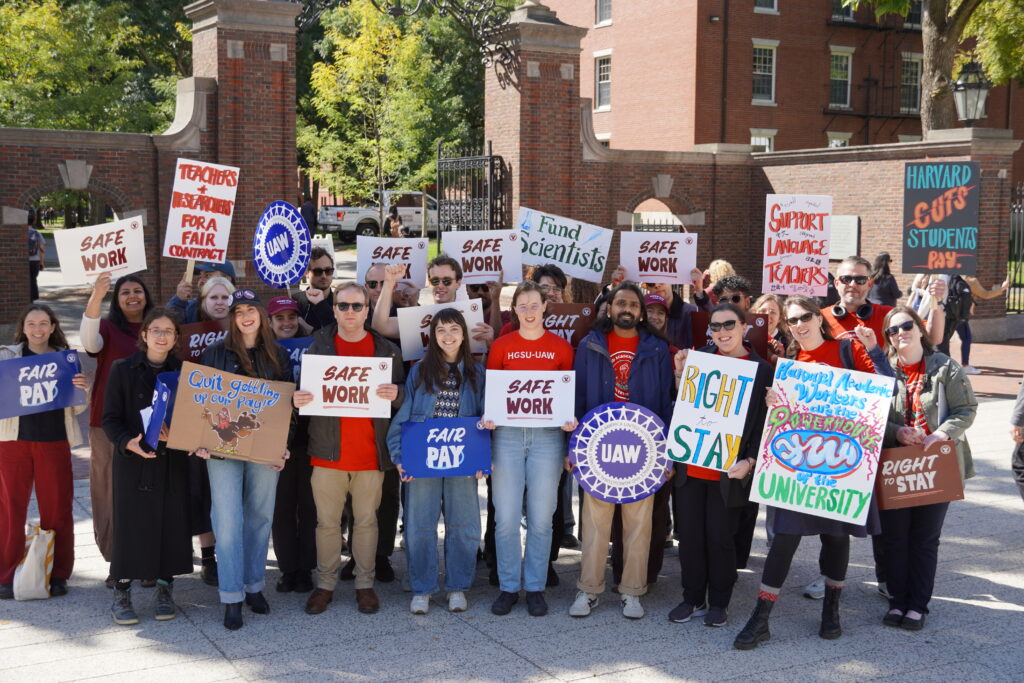
We have been bargaining since February 2025. Since then, we have reached agreement on nine (9) contract articles, which have won PhD students fully covered dental premiums, retaliation protections, funding transparency, private workspaces, and more. We won these agreements because of our historic, 40-day strike in the spring. Before our strike threat, we only had agreement on one (1) article. After the events of our 40 day spring strike, this rose to 9 articles by the end of the summer (see all bargaining updates here). We all know what a strike costs. Our spring strike demanded real sacrifice from all of us, and we made it for each other. We also know that our strike power is the only thing that has moved Harvard at the table over the past 19 months.
However, through the end of the summer, Harvard has stalled negotiations. They brought 0 proposals to the first three bargaining sessions in the fall. We ended our spring strike because the University committed to make progress on our issues, which they began to do at the start of the summer. However, the University then began backpedaling, beginning the fall with three consecutive sessions in which they brought no proposals, counters, or points of discussion. Our bargaining committee called for a second Strike Authorization Vote. This vote resulted in 1,710 student workers voting by a 88% majority to authorize strike action.
Our strike authorization vote moved them somewhat, and they brought small progress in the session immediately after our vote – offering 3% raises (below this year’s inflation rate of 3.7%) and some movement on disability accommodations timelines. But they’re still offering a contract worse than our last: it removes nearly $3 million in benefit funds (and removes access for all non-PhD students), eliminates healthcare, dental, and disability expense reimbursements, cuts the benefits parents receive in half, and guts critical support for non-citizen workers. This is unacceptable.
Student workers do not take the decision to strike lightly, and this overwhelming result is an indication of the disappointment that we are feeling. We are committed to winning adequate compensation for our members, access to third party arbitration in cases of harassment and discrimination, and expanded protections for non citizen workers. In short, safe work, fair pay, and the right to stay.
These are not “nice-to-haves”: they determine whether our coworkers can afford rent, childcare, and healthcare; whether we must take second and third jobs; whether international workers can remain in the country; and whether we can finish our degrees at all. These issues have all been meaningful engaged with at several other Universities. Harvard is the most resource-rich university in this country–it has the ability to meet our demands and is refusing to do so. Read more about our core issues here.
Our bargaining committee is doing everything in their power to reach a deal with Harvard before this strike becomes necessary. At our recent session on October 8th, we presented the University with a comprehensive package, making concessions on many of our core issues. We have also requested additional bargaining dates before the strike deadline. It is now up to the University to demonstrate to student workers that they are serious about reaching a fair agreement. We sincerely hope that they do so. In the event that they do not, we will be prepared to strike.
A strike is no one’s first option, and we will do whatever we can to avoid a strike. However, Harvard does not respond to our other actions – they ignore reasoned arguments at the table, testimonies, petitions, rallies, phone-zaps, and other forms of pressure we have tried to exert. They have, however, responded to our strike power:
- We reached agreement on eight (8) of our nine (9) settled articles after our spring strike.
- Our last contract in 2021 was settled after a threat of a second strike.
Harvard has made our options clear: we must prepare to strike again for a contract that is not worse than our previous.
You are not obligated to strike if you voted “Yes.” However, a strike is only effective through mass participation. What we win in our contract depends upon our unity in a strike, should one be called. You are also welcome to participate in the strike if you did not participate in the strike authorization vote!
There are two elements of a strike: withholding labor and picketing.
- Withholding labor means that we would cease doing the labor protected by our contract. For graduate students in teaching roles (TFs, CAs), striking means that we will not do any of our teaching-related work. We will not hold sections, attend teaching meetings, meet with students in office hours, or grade assignments. Similarly, graduate students employed in research positions (RAs) on a part-time or hourly basis will not perform any of their research work. Striking full-time student researchers will, however, be able to perform necessary maintenance work and other activities necessary to safeguard ongoing experiments and their academic progress.
- Picketing makes the absence of our labor visible to the broader University community and lets them know what we are fighting for. Check out this video of our very first strike in 2019. This strike won us our first contract, which included guaranteed sick leave, guaranteed raises, an independent process to adjudicate workplace disputes, and nearly $1 million to support childcare and healthcare expenses.
We know that the lines between your academic work (which you should not strike from) and labor you do for the University can be blurry. To address this, we have developed specific strike guides/worksheets to help support workers in understanding what work they should withhold. Contact your stewards directly with any questions and to develop specific strike plans that make sense for you!
The strike deadline we have communicated to the University is 11:59pm October 26, 2026. This means that, barring significant movement from the administration on our contract, we will begin striking on October 27, 2026.
Ending a strike is a democratic decision that will occur when members feel we have reached a sufficient “tentative agreement” (TA) on our contract. Members will then vote to ratify this TA, and if that vote passes, that TA will become our contract. As above, we will make this decision in membership meetings. Come to meetings!
It is illegal for faculty to retaliate against a striking student worker. Faculty are legally barred from trying to fire striking students; punishing striking students by refusing to hire them in the future; forcing students to work overtime after the strike; engaging in verbal intimidation, threats, or bullying; attempting to hurt a striking student’s professional reputation, including in letters of recommendation; or pursuing any other formal or informal disciplinary measures.
The Harvard administration is not required to cut the pay of any graduate worker engaging in their legal right to strike. However, they may choose to do so to intimidate or otherwise coerce a worker to continue working. Given this risk, to support our right to strike, our parent union, the United Auto Workers (UAW), has created a Strike Fund that supports striking workers and that is funded by our dues and the dues of other UAW members. The Strike Fund provides $550/wk to workers on strike, as strike pay. Strike pay is taxable. You must be a member to be eligible for strike pay; you can sign up here!
To be eligible for strike pay, workers must perform strike duties for at least 7h/wk for hourly workers and 10h/wk for salaried workers. Both citizen and non-citizen student workers can legally receive strike pay. If you were carved out, you will need to sign up to pay dues through the union to be eligible for strike pay – you can sign up here.
Strike duties are varied and will include being outside on pickets, drafting communications about the strike, creating strike materials, etc. More information about strike duties will be finalized soon.
We will also have a hardship fund which may help provide support to striking workers beyond strike pay. We will provide updates about any such funds soon!
Yes. The right to strike is protected by the National Labor Relations Act (NLRA), which allows unions to engage in concerted activities to bargain collectively. However, in order to be protected by this right, you must strike fully from your job and cannot pick and choose what you strike from (known as “partial striking”).
The NLRA does not differentiate between citizens and non-citizens. The right to strike applies equally to U.S. citizens and noncitizens, meaning that you have the same rights and protections for striking as domestic workers (as well as to join a union, vote in union elections, and engage in other union activities). Further, U.S. Citizenship and Immigration Services (USCIS) cannot ask you questions about your union membership or participation in lawful union activity. Nor can they use such information in determining the outcome of your immigration/visa application. Out of tens of thousands of international graduate students, postdocs, and researchers that are part of UAW, there has never been any reported instances of participation in a union negatively impacting visa or permanent residency applications, including during our first strike which occurred under the first Trump administration and our spring strike.
We understand that under the current Trump administration, workers have concerns that legal protections don’t matter. We have created guidance for international workers who may have questions about how best to participate in this strike – please email [email protected] for this guide and to talk through your specific situation.
The UAW’s (our parent union) position is that carved out workers are workers, and as such, they have the legal right to strike. In fact, we anticipate the University will lose its frivolous attempts to delay a ruling in our favor on this issue (as it recently has, for the third time, in their attempts to carve out workers in the Psychology department). Workers in carved-out positions participated in our labor strikes in both 2019, 2021, and the spring without any repercussions. As with all striking research assistants, the strike should not impact your academic progress, which will limit Harvard’s ability to retaliate as they do not consider carved out workers employees (contact your stewards for the RA strike guide, which has more details).
Ultimately, our power and protection comes from our numbers. The more carved out workers that strike, the harder it is for Harvard to retaliate, and the easier it is for us to win a new contract – which would pave an easier legal path for us to fight our carved-out status.
No one wants to go on strike; a strike is our last resort to securing a fair contract. The possibility of striking, and its impact on undergraduate education is extremely powerful. One of the major turning points of the HUDS strike in 2016 was when undergrads’ well-being was impacted, and parents started calling the university.
Historically, undergraduates have been very supportive of our cause since they know better than anyone that Harvard works because we do, including during our spring strike – see an op-ed by the Crimson Editorial Board here and a petition signed by over 400 undergraduates here.
And ultimately, the provisions we’re fighting for in our contract will help us be better teachers. Healthy, protected, and financially stable student workers can devote more time and energy to teaching. It’s precisely because we care about our students that we are devoted to securing the contract protections that will allow us to be the best teachers we can be.
The University has claimed that they might view a potential strike by HGSU “intermittent.” In no uncertain terms: the University’s statement is false, is not supported by labor law, and is a scare tactic designed to prevent student workers from exercising their legal right to collective action.
The National Labor Relations Board (NLRB) has made it abundantly clear that employees are not unprotected if they engage in more than one work stoppage, even over the same issues. In Walmart Stores, Inc., 368 NLRB No. 24 (2019), the NLRB defined an intermittent strike as follows: an “intermittent strike unprotected by the Act is a strike pursuant to ‘a plan to strike, return to work, and strike again.’” Any suggestion that HGSU has ever made such a plan is patently false.
The NLRB then continued:”We are certainly not suggesting that employees who go on strike cannot go on strike again based on even the same demands as the first. Deciding later that circumstances warrant going on another strike is fundamentally different than planning a strategy to strike, return to work, and strike again for a more damaging effect with less risk.”
Two strikes, separated by at least 4 months, authorized by separate membership-wide votes, and called at different stages in the bargaining process clearly do not constitute intermittent striking.
The University’s messaging continues its pattern of unlawfully attempting to stop our union from fighting for the contract we so desperately need.
We will not accept these intimidation tactics. We have sent a response to the University making it clear that the University’s messaging has no basis in law, and we will continue to fight against this baseless posturing. Ultimately, our safety as workers is ensured by our commitment to collective action and our strength in numbers. Together we can, and will, win safe work, fair pay, and the right to stay for all student workers at Harvard.
The most important thing is to be visible in the strike. Your PI/supervisor may ask for reporting purposes both to the administration as well as potentially for effort-reporting purposes: say yes, you’re on strike! You should also withhold your paid labor, which is 20 hours a week. You should not withhold any labor related to your academic work. We understand the difference can be confusing, so we have made guides – contact your stewards for the RA strike guide, for the details!
The Harvard administration will likely start writing to faculty and other members of the Harvard community about a strike not being necessary, about how they are negotiating in good faith, about how they couldn’t possibly afford our proposals, and how we are overreacting. Here’s some responses we have to concerns they may raise:
- “We cannot afford these proposals!” They can – see here.
- “The strike is not necessary – we can continue the bargaining process as normal to make progress on the issues the union has raised.” We have been bargaining in good faith for a year and half, and the University has rejected the vast majority of our proposals without any alternatives to the issues we have raised. When they have responded, they have at times taken away existing rights and protections, like taking away language that guarantees the right to union representation during harassment, discrimination, and bullying proceedings and removing protected identity categories in favor of a University policy they can change at will (an especially frightening position as they are actively bargaining with the Trump administration). While our strike led to some movement on the part of the University, resulting in nine (9) agreements, the University’s willingness to make movement at the table has stalled, and they do not feel any urgency to respond to our proposals or take our issues seriously at the bargaining table. It has been a year and a half of arguments, rallies, testimonials, and petitions to no avail – we are still far apart on our core issues. There’s no reason to trust that simply doing more of the same will lead to any movement on winning safe work, fair pay, or the right to stay.
- “A strike harms our University community/students.” The point of a strike is to disrupt the normal operations of the University. However, it’s not the case that it harms others. In previous strikes, many students have learned a great deal from coming out to the picket and supporting their teachers and lab mentors. It’s also important to recenter in why we would strike – a strike is a last resort and not anyone’s first option. We would strike because all other options to win the rights and protections we deserve have been exhausted. And ultimately, if the University thinks a strike would be so harmful, they have the power to stop it by working with us on our proposals. We’re not asking for the world – we’re simply asking to be able to afford to live and to be safe in our workplaces, and the richest and most prestigious University in the world can surely make that happen.
- “Strike actions violate our Campus Use Rules” Campus Use Rules (see fn. 2) do not apply to protected union activity covered under the National Labor Relations Act (NLRA), which includes strike actions.
- “Striking may mean that you fail to meet certain academic requirements and inhibit your degree progress” We are not striking from our work as students, but as workers. As such, our academic requirements/degree progress should not be threatened through strike actions. We understand that drawing this line can at times be confusing, especially for research assistants (RAs). We encourage RAs to contact their stewards for strike guides that help navigate these concerns.
- “We’ve made a fair and generous offer” They sure haven’t! We have made no progress on any of our core demands, and the University’s bargaining team has rejected the vast majority of the language across our proposals. See our bargaining tracker for the session-by-session breakdown. Furthermore, all of our demands are merely trying to keep pace with other peer institutions who already meet or exceed what we are currently fighting for. After a year and a half of bargaining on these issues and a year without access to the benefit funds our workers rely on for childcare, healthcare, and emergency expenses, our decision-making must be anchored in what we think will work. Ultimately members decide whether we strike, and we would encourage you, amidst the University talking points to ask yourself – what do you think it will take to win?
