
On Thursday, 9/24, our Bargaining Committee sat down with Harvard again with clear questions on benefits, accessible transit, leaves, health and safety, and non-citizen worker rights. Harvard came to the table with zero proposals. This session underscores why our bargaining committee has called for a Strike Authorization Vote, and we want to walk you through exactly what happened so you can see for yourself.
Harvard Had No Proposals. For the Third Session in a Row.
Despite Harvard showing up for the third time empty-handed, we came with a benefits counter and a list of questions across five open issues. Harvard came with nothing.
Benefits
We presented a real counter with our benefits proposal, making significant movement. We agreed to cap the fund rather than ask for annual increases, and we agreed to give up union oversight of fund administration in exchange for a real grievance process if someone is wrongly denied a benefit they’re entitled to. We also pushed to speed up disbursement timelines so families and workers with emergencies aren’t waiting a full semester for reimbursement.
Harvard spent the conversation asking clarifying questions rather than responding with movement of their own: how the funds would be divided between members and non-members, whether disability-related expenses would need to be submitted to insurance first (a serious problem, since insurance often won’t cover a second mobility aid or duplicate equipment), and how retroactive applications might work for members who’ve been sitting on receipts for over a year while this benefits fight drags on. These are fair questions. But after months of back-and-forth, Harvard still could not tell us whether the childcare fund covers actual documented need, whether hourly workers will have meaningful access, or which articles this proposal is even meant to replace. They promised to “look into it and get back to us.”
Health & Safety (Article 10)
We have two outstanding pieces of Article 10: the mental health crisis response team and disability accommodation timelines. On the mental health response team, Harvard offered to bring in HUHS and HUPD leadership to explain why they believe current practices are already effective and why they continue to refuse engaging with our proposal. We agreed to hear them out, but were clear that we’ve already heard extensively from student workers about how current practices are failing them, and that repeatedly rejecting a proposal is not a substitute for engaging with it.
On accommodation timelines, we made a real breakthrough in exposing an inconsistency with how Harvard treats other unions on campus. Harvard has told us for over a year that a specific accommodations timeline is not workable because a standard interactive process can’t be reduced to a deadline. But when we pointed out that Harvard already agreed to a timeline with another contract, Harvard’s own team paused. When we asked why Harvard hasn’t simply proposed that same language to us, given that they’ve already agreed to it elsewhere, we only got a suggestion that we should be the ones proposing it. We plan to model our language on this example and expect Harvard to accept the standard they’ve already agreed applies to other unionized workers on this campus.
Leaves
We asked, again, for any update on medical leave, parental leave, or short-term disability leave. Harvard’s answer: nothing new. They pointed to language in our previous contracts, which is exactly that language we are trying to improve. Workers are compromising their health, going into debt, and struggling to stay enrolled under the current policy. We made clear this remains one of our top priorities and that repeating past language is not a proposal.
Accessible Transit
No update on expanding the shuttle or rideshare program. Harvard says they’re “still working on it,” but declined to commit to having language ready for our next session.
Non-Citizen Worker Rights
We pushed hard on I-9 processing timelines, and Harvard’s team acknowledged real problems with our proposed 10-day window, citing high-volume periods and emergency hiring situations. We’re willing to work through that and to find language that addresses their operational concerns while still protecting workers.
But the harder conversation was over Section 9, which is our request that Harvard’s own Office of General Counsel (OGC) guidelines on responding to ICE and immigration enforcement, guidelines Harvard says it already follows, be written into our contract. Harvard’s answer was direct: they will not put their own policy in writing, because they want to preserve the ability to change it later.
We were direct back in our response. This is exactly the gap that left students at Columbia unprotected when their university’s policies shifted and students were detained. We are not asking Harvard to exceed constitutional protections. We are asking them to commit, in writing, to the standard they say they already meet. As it stands, Harvard says it likes its own policy, but won’t guarantee it.
WHY WE’RE ASKING MEMBERS TO VOTE ON AN SAV
Near the end of the session, Harvard pointed to articles still open and suggested that the sheer number of proposals is why nothing is closing. We pointed out that our last contract cycle also opened a similar number of articles, and that negotiation took nine months, not the nineteen we’re currently at. Harvard also pushed us to bring a full compensation package, arguing that wages are the most significant economic issue on the table. We were clear that compensation is not separable from benefits, leaves, and health and safety. Asking our members to accept an insufficient wage increase while Harvard simultaneously guts childcare support and won’t commit to protecting disabled and non-citizen workers isn’t a serious way to reach a deal.
This session reflects a pattern we’ve seen for months. Again and again, we see real movement and engagement from our side, and mostly clarifying questions, old language, and “we’ll get back to you” from Harvard’s. We’ve tried testimonials, counters, and patient engagement session after session. A Strike Authorization Vote means giving our bargaining committee the leverage needed to make clear to Harvard that our membership is serious, prepared, and not willing to wait indefinitely for movement from Harvard that hasn’t materialized.
Our next bargaining session is October 8. We’re done waiting for Harvard to decide when they’re ready. This spring, we showed Harvard what our power looks like. It’s time to remind them.
On Thursday, 9/10, our Bargaining Committee met with the University again. We covered compensation, non-citizen worker rights, leaves, accessible transit, a transition support fund, and a follow-up on the benefit fund after powerful testimonies last session. We came with clear questions and were prepared to engage with the articles to make progress, but Harvard had a different story. Across nearly every issue, the same pattern held: Harvard offered explanations, calculations, and vague reassurances, but little in the way of real commitments. They did not arrive with a single proposal or question for HGSU.
Compensation
At our last session, Harvard finally acknowledged the pay disparity between TFs and RAs and put forward a proposal to close the gap. This week, they walked us through their math.
Harvard’s formula for pay parity compares pay for the hours worked as a TF to those of an RA. But in practice, that results in a TF teaching a standard 2-section courseload taking home significantly less than an RA based on an expected 7 hours per section per week. Harvard’s proposal only achieves “parity” if a TF takes on a third section, working closer to 20 hours a week to match an RA’s expected workload. We do not think it is unreasonable to ask that student workers doing the standard, expected teaching load are able to make ends meet without picking up extra sections.
This isn’t about nickel-and-diming for extra hours. Instead, TF pay for some departments is currently far below the cost of living in the greater Boston area. Graduate workers are already balancing responsibilities for children, healthcare, and rising costs, on top of losing access to the benefit funds that used to help cover the gap. Harvard’s compensation proposal doesn’t reflect the reality of what it takes to live in this city while performing our jobs.
Non-Citizen Worker Rights
We spent a significant portion of this session on our proposal to extend the leave request window for non-citizen workers from 5 to 10 business days. This is a change meant to give non-citizen student workers enough time to resolve visa and documentation issues abroad without losing their positions.
While Harvard asked us specific questions about specific cases, we were direct about why we cannot simply hand over that information. Non-citizen workers are already navigating an increasingly hostile federal landscape, and reasonable fears of being identified, flagged, or retaliated against for coming forward, especially when they don’t know what data Harvard shares with federal immigration authorities. HGSU is not willing to ask workers to attach their name and department to a story about visa problems, possibly risking their safety for the sake of a bargaining table conversation.
Harvard’s team suggested that the current “reasonable consideration” language should already handle these situations, but we pointed out that “reasonable” is exactly the problem. It gives total discretion to individual supervisors and department administrators, many of whom are also fearful of non-citizen worker policy, creating a system where two workers with identical circumstances can have completely different outcomes.
We also discussed our proposal to enshrine current Office of General Counsel (OGC) guidance on responding to immigration enforcement into our contract. Harvard would not commit to keeping this language, citing concerns about “enforceability” if federal law changes, which is exactly the kind of instability that makes our members afraid their protections could disappear overnight.
Leaves
For paid parental and disability leave, Harvard had nothing new to report. They mentioned they are working on language to clarify that a student worker leave doesn’t automatically trigger an academic leave, which is a small step, but refused to give a timeline for anything more substantial, including on the question of how short-term disability leave might be administered. We again made clear that this remains one of our top priorities, and that this is a basic protection that most workers in Massachusetts already have.
Accessible Transit
Harvard indicated they are actively working on a proposal for accessible transit and expressed cautious optimism that something workable is coming. We’ll be watching closely to see if that materializes into real language.
Transition Support Fund
We followed up on the lab Transition Support Fund, modeled on MIT’s program, which Harvard signaled progress on back in July. Once again, Harvard had nothing concrete to share, though they committed to trying to have an update before our next off-the-record session, again providing the repeated line of “we’ll try.” This is a program Harvard is attempting to make available outside of our contract, which means they can change eligibility, the type of support, or cancel the program without notice.
Benefits Fund Access
Following last session’s worker testimonies on the importance of our union benefit funds, we came back this week with hard data. One of our bargaining committee members shared their own experience applying to the University’s new emergency hardship fund as a test case: they were denied. The University’s own denial email stated that the new fund “may not fund all the same expenses as the Union did,” and in practice, it hasn’t funded any of them.
We walked Harvard through thousands of dollars in real medical and emergency expenses that would have been covered under our union-run funds and are now falling through the cracks, including urgent medical costs that Harvard’s new fund apparently classifies as “routine.” We also raised serious concerns about childcare funds, as workers who previously qualified for support are now being told they’re ineligible, and Harvard could not tell us whether families are receiving more or less support than before.
Harvard’s response was to note that these policies are under review. We asked directly: is the dollar amount changing? Is the eligibility changing? Will everyone who applies receive funding? Harvard could not—and would not—answer. We have asked for actual data, disbursement numbers, approval rates, anything that would let us evaluate whether this new system is more or less equitable than what we had under our last contract. So far, we have received nothing. Not a single non-citizen worker has been able to access Harvard’s new international worker fund for expenses that were previously covered under our union fund.
We will not accept a benefits proposal that leaves our members worse off, and right now, every piece of evidence we have says that’s exactly what’s happening.
Moving into the Fall
Harvard closed the session by restating, for what feels like the dozenth time, that they will not move on union security or non-discrimination protections. They were clear and unambiguous about it. In addition to their refusal to move on union security and non-discrimination, Harvard has made clear they are not moving on benefit fund access either. We do not accept that any of these three issues are off the table. We will continue to organize and escalate until Harvard understands that a fair contract includes these fundamental protections for our workers.
Harvard is waiting on our compensation counterproposal, and we intend to deliver one that reflects what our members actually need to live and work in Boston, not a formula that only works on paper.
We have more sessions ahead of us this fall, and we are pushing hard for real data, real timelines, and real movement on the issues that matter most to our members. If you have a story about the benefit funds, immigration leave, or any of the issues discussed above, we want to hear from you. Email us at [email protected].
On Friday, 8/28, our bargaining committee met once again with the University to try to reach a resolution on our contract. The focus of this session was our union benefit funds. These funds, a crucial resource for our members that have made life at this University more liveable over the past several years, included dental, healthcare, child care, dependent insurance, emergency, international, and legal funds. Since the expiration of our contract in July 2025, student workers have not had access to any of these funds and, in recent negotiations, the University has proposed removing all union run benefit funds and instead consolidating such benefits under full University control. Unfortunately, the funds offered by the university are much more restrictive and difficult to access than our previous union run funds, exclude all non-PhD workers, and if a student worker is denied benefits through these funds we have no recourse as a union. As a result of the University’s changes we would see:
- No funding available for healthcare and dental care, as was previously allowed for under our benefit funds
- No childcare or dependent care funds – the University has already denied many student workers access to the funds it has newly created who would have otherwise received coverage under our funds
- No funds for workers to cover costs associated with disabilities or chronic illnesses
- No funding available to support various expenses for non-citizens renewing visas or to pay for legal costs of representation in cases of emergency
To respond to this dangerous proposal, we brought in 13 student workers in programs across our school to give testimonials on the importance of these funds. Our members recounted stories to the University’s bargaining team about having a source of comfort on the way to the hospital because they knew that a medical emergency would not lead to financial ruin. They talked about unexpected disasters that upended their lives, but that they were able to overcome because of their ability to access emergency funds. They talked about management of chronic illness and how difficult this is to do on what this University provides in salary and benefits, but that our union has been able to fill in the gaps. They talked about the enormous cost and difficulty of childcare, and about how the new university administered funds are both inadequate, and restrictive in ways that leave students ineligible based on technicalities. One student worker is due to have a child just days after the application period expires; the fund cannot be accessed, there are no exceptions. Our members showed incredible courage in recounting these stories, and they left the University with one simple question.
What are we supposed to do?
What are those of us with chronic illnesses supposed to do when we can’t make ends meet? What are we supposed to do when we suffer an unexpected medical emergency and we don’t have money set aside? What are we supposed to do if our partner loses their job, and we no longer have the funds to afford childcare? This University accepted us into our programs because they expect us to be the best in the world at what we do. We cannot do that if we don’t have the resources necessary to live dignified lives. We cannot do that while rationing medicine.
The University’s response to the honesty and vulnerability of our members was disappointing. They told us that they would take these stories under consideration, and added that some of what was discussed was “outside the scope of what a University can provide to its students”. We disagree. These funds are essential to our members, and we will fight hard to ensure that they remain available to us.
Join the fight for a new contract
The issues that our union is fighting over are not abstract, they have real concrete impacts on the lives of every student worker at this University. This fall we will be organizing hard to ensure our next contract provides student workers with the dignified life that they deserve. There are turf socials and events happening across campus in the coming weeks. Please get in touch and get involved!
On Tuesday 8/18, we met with the University once again hoping to see movement on our core issues before the beginning of the fall semester. We are happy to report that the University has begun to make movements, particularly on the issue of pay parity, but these proposals still fall short of what our workers ultimately need.
The University’s Proposal
Over the past 18 months, we have repeatedly told the University that there are major issues with pay parity in our unit. Teaching Assistants are paid less than Research Assistants, and one of our priorities as a union is to bring TA pay in line with RA pay. On Tuesday the University acknowledged, for the first time, that they do not pay their workers equally. “We agree”, they told us, and presented a plan to bring TA pay in line with RA pay. Their proposal involves paying TAs an enhanced senior rate of $7,326 per section. Their bargaining team also clarified that this senior rate will be applied to all student workers enrolled in a PhD program, where previously senior rates had only applied to those that had completed their first two years. These are both highly encouraging steps in the right direction. However, if you’re doing the math, you might notice that the TA rate proposed here, if spread across the usual full teaching load of 2 sections per semester, is not equivalent to the proposed RA pay rate of $51,972. The University explains that these numbers are pro-rated based on the expected RA workload of 20 hours per week, 12 months per year. TA positions cover 10 months of the year, and the University’s expectation is that a full teaching load is not 20 hours, but rather 14 hours (7 hours per section). In practice of course, many of our members regularly work more than 14 hours per week on two sections, and so further discussions will have to be held with the University on this issue to ensure that our workers are compensated fairly. Additionally, parity aside the current compensation proposals for both TAs and RAs still fall short of the living wage that we are asking for. We are, however, very glad to see the University begin to move on one of our core issues. We would not have achieved these concessions without the amazing organizing of our membership during this contract cycle, and the commitment that our union made to pulling off the longest strike in our history last spring.
Our proposals
On Tuesday we also presented our own proposals on five articles:
Article 10, Health and Safety
Article 13, International Student Worker Rights
Article 18, Union Access and Rights
Article 26, Leaves,
and Article 20, accessible transit.
We have been working with the University on all of these articles to come closer to an agreement and after reaching tentative agreements on 7 articles in our last session we are hopeful that many of these articles will soon be ready to close. Our organizing outside the bargaining room continues to incentivize the University to agree to a contract that enshrines these crucial rights and protections for its workers.
Looking towards the fall
Our next bargaining date is scheduled for Friday, the 28th of August. There we will be bringing worker testimony to the University about the importance of our union benefits funds, and how stripping these funds will impact the lives of our members. WE NEED YOUR TESTIMONIES! If you are interested in giving testimony at this session, get in contact! ([email protected]). As for September bargaining dates, we don’t have them yet, and we need them soon. With the beginning of classes right around the corner, we need to see serious movement from the University on the core issues of our membership.
We would all much rather be teaching and researching than continuing to fight our employer for safe work, fair pay and the right to stay (keep an eye out for our new contract campaign slogan on a flyer near you). Looking ahead, we encourage Harvard’s bargaining team to meet the needs of our workers if they wish to avoid further disruption in the Fall semester.
If you are interested in organizing to win a fair contract for all student workers at Harvard, get in contact!
Two months ago, we ended the longest strike in our union’s history. Since then, we know many of you have been wondering: did it work? At our last session, we got an answer. Coming in with a clear mandate from membership to close articles and demonstrate real movement, we used the momentum from our strike to close Academic Freedom, Job Postings, Training, Workload, Appointment Letters, Grievance and Arbitration, and IP and Scholarly Research Misconduct, so we can direct every ounce of our power toward the fights that matter most: wages, non-citizen and disabled workers’ rights, Real Recourse, and benefits funds. By the end of the session, we had seven articles off the table.
This kind of movement after months of stalling is not a coincidence. The strike built the pressure that pushed Harvard to bring these articles to the finish line. Closing them out now is how we sharpen our focus on what is left. Harvard administration may see this as momentum toward a fair contract, or they may see an opening to push back. How relentlessly and skillfully we organize between now and the start of the semester will determine which way this goes. We need to make it unmistakably clear that we are not going away until we get what we deserve.
What We Won
Closing articles is not just housekeeping. Here is what these TAs actually mean for workers:
- Real, enforceable retaliation protections. We have been at this table for years fighting to make sure that workers who speak up are protected. If you seek help from HGSU, raise a workplace complaint, and are retaliated against, you can now grieve and pursue that complaint through an independent, neutral process.
- A longer grievance timeline. We added five business days to the window for filing a formal grievance. We have had hundreds of grievances that could not be filed because the timeline expired. This gives workers more time to assert their rights.
- Transparency about your funding. Appointment letters will now include information about the source of your funding, so you finally know who is paying you.
- More detailed appointment letters. Letters will now include information about tax withholding and who to contact if you have a pay issue.
On AI
Harvard finally put something on paper and presented a Memorandum of Understanding that would create a standing forum to discuss how changes to Harvard’s AI policies affect our working conditions. Honestly, a discussion forum is not the same as enforceable protections, and we have real concerns about this language. We are not accepting it yet. As a signal of good faith, we withdrew our AI language from IP and Scholarly Research Misconduct and TA’d the rest of the article. AI protections are still a live issue and we will keep pushing.
What’s Coming in August
Harvard gave us two significant signals today:
- Paid leave for parents and sick or disabled workers. Every worker in Massachusetts has this right. Every worker, that is, except graduate student workers. Harvard is actively working through proposals and expects to bring something to the table in August.
- Lab transition support. Harvard is working on implementing a program modeled on MIT’s transitional support program, providing a semester of support for workers who need to transition labs due to bullying, harassment, or discrimination. We expect updates in August.
While these are not agreements, they are movement, and we intend to hold Harvard to delivering on them.
Our next session is scheduled for August 18. Join our slack channel at #ask-bargaining or email us at [email protected] if you have any questions as we move into the fall.
Harvard came in with a so-called “partial package” covering Appointment Letters, Grievance & Arbitration, IP, and Workload, trying to lock in small fixes while continuing to stonewall on our biggest issues. While we are making real movement on some articles, but as we narrow what’s left on the table, it’s becoming clearer that Harvard is not ready to move on the issues that matter most to our members.
Appointment Letters
We’ve said it repeatedly: late letters mean missed paychecks and missed rent. In a step forward, Harvard confirmed that even if an appointment letter is late, workers are paid for the full appointment. This is important, but we maintain our position that:
- Letters should not be late in the first place
- Workers owed back pay should receive it in a lump sum, not parceled out across weeks when they needed it weeks ago
Harvard hid behind “payroll mechanics” and claimed a simple pay advance is too complicated. We did not TA Article 3.
We also got something important on the record: Harvard defined a standard section as 18 students and 7 hours of work per week. With PhD admissions shrinking, having that definition documented is a tool we can use to ensure we are not overworked.
Grievance and Arbitration
Harvard agreed to our broader anti-retaliation language, we submitted a clean counter, and we’re ready to TA. Harvard is the only thing standing in the way of closing this article.
IP and AI
We’re close on this language, but Harvard (if Commencement was any indication) is not interested in real policies for AI. However, we were clear: no AI protections, no TA.
Legal Expense Fund
Harvard actually admitted their proposed fund for legal expenses (only for PhD student workers) doesn’t cover Title IX cases that can run $40,000 or more, or several immigration-related legal costs for non-citizen workers, and then still refused to move. We updated our proposal to address their past objections, but they rehashed old arguments and produced no counter. They also failed to answer questions about why HLS students get the costs of lawyers for Title IX cases covered but no one else does!
Union Access & Rights and Benefits Funds
On Union Access & Rights, Harvard claimed they have new draft language but haven’t even shared it with their own team. On our benefits and union-administered funds, covering healthcare, emergency, dental, legal, childcare, and non-citizen support, we have been waiting since our May 14 counter. Harvard’s answer today was simply: “we’re staying where we are.” They said this knowing it was the last bargaining session for two of our key committee members, Lindsey and Ryan, who have driven much of this work.
There are many ways to be part of this fight, and serving on the bargaining committee is one of them. We are currently in a period of bargaining committee elections. Consider accepting a nomination and email [email protected] with any questions.
Happy Birthday to Article 13, Non-Citizen Student Worker Rights and Work Authorization, and to Article 18, Union Access and Rights! The strength and dedication this whole union shows to winning a fair contract for ourselves and all the workers yet to come is commendable, but why is Harvard still coming to the table underprepared and underinformed? We should not have to celebrate articles being open for over a year while Harvard asks the same questions session after session.
At the table on June 9 we had discussions surrounding how Artificial Intelligence will reshape higher education and our roles as Student Workers, how delays in providing disability accommodations at the University leave Student Workers unable to complete their job functions, and how Harvard has dramatically fallen behind peer institutions for compensating Student Workers in all job classifications.
Harvard denied us access to seats on committees with community input on topics related to AI at Harvard, asking us why we should even have input. We reminded them that Student Workers at Harvard are actually doing the grading, and we have the most experience with the rampant and uncontained use of AI in student work. We not only want to be present for discussions of how AI will be used and restricted in student education, but also in discussions of how our research may or may not be used to train future AI models. Why does Harvard not want our input when many of these committees are asking for community input?
Next we discussed Harvard’s hesitance to even engage in conversation around disability accommodations in our roles as student workers. Workers frequently cannot perform job functions because the accommodations process would rather route us into a grievance procedure, which can take 90 days, than to have informal meetings with us at the beginning of a semester when the issues are identified. We like our jobs and take pride in our research and teaching so why is Harvard systemically denying disabled workers the resources they need to perform essential job functions?
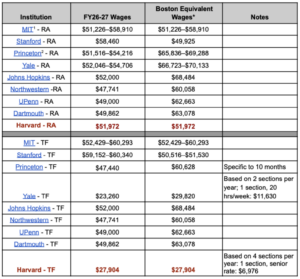
Finally today we brought irrefutable proof to Harvard that they have fallen behind peer institutions in terms of wages for TF and RA positions. While we have repeatedly told them of this issue at the table and cited universities that pay their workers more, Harvard has refused to do the work to look into those contracts. Today, we did their work for them as we often do and presented a table (below) that shows the pay rates for different peer institutions. They can no longer argue that they have not fallen behind in compensation and this table can be circulated to upper administration to demonstrate that we are undercompensated.
Our next session is June 23rd where we hope to see movement from Harvard since they have committed to providing counters on several of the articles we discussed today.
TLDR: Our strike has broken Harvard’s chronic stonewalling behavior at the bargaining table!
An 🌊ocean of gratitude 🌊 for our striking workers! 🫡🧑🏫🧑🔬🧑🎓🧌🥷🚶♂️➡️👨💻📣 38 days on strike is HGSU’s longest strike so far, and we made major impacts across Harvard. Over 300 student workers demonstrated our power at commencement, by respectfully celebrating our graduates while making our demands clear. And thank you 💯 to Boston Mayor Michelle Wu, who refused to cross our commencement picket line! The latest from our May 29th bargaining session:
Our strike forced Harvard to begin REAL bargaining 👊
What bargaining has been like the past year:
- HGSU clearly outlines a problem in our contract
- Students deliver heartfelt testimonies
- Harvard HR tries to waste our time by nitpicking grammar
- Harvard lawyers say “we’ll consider it”, then do nothing for 6 months
Today, Harvard’s main grammar-nitpickers were sidelined, and we FINALLY had substantive conversations about our articles with actual policymakers on Harvard’s bargaining team. School-specific administrators were asking specific questions about our proposals, looking into how other unions implement our proposals (like we have been begging them to do), and writing down questions to bring back to their bosses. This is what actual bargaining looks like! Our strike has forced Harvard to stop stonewalling and make progress at the table.
Harvard’s administrators are still out of touch 😶🌫️
Now that we’re bargaining for real, Harvard has to understand our issues, but they still have a long way to go. At today’s bargaining session:
- Harvard lawyers referred to our childcare proposal as “generous” and “a bit extreme” (avg childcare is ~$36,000/yr, union proposed $17,000, Harvard proposed $6,500, but offers faculty >$12,000 😵💫).
- They claimed administering benefits—what our union has done with a committee of volunteers for years—would be “an enormous amount of work”, and that our benefits proposal is too long (it’s 2 pages, they are highly paid lawyers).
- For TF/RA pay equity, when we mentioned that TFs under Harvard’s proposal would still be SNAP eligible, even in 2029 ($29k/yr), a Harvard lawyer told us “you can make extra in the summer … [you’re] playing with those numbers to make it far worse than it is.” (btw, TFs at MIT make >$40,000 year for the same workload 🤔🤔).
Our strike pressured Harvard to begin making movement on core issues ⏲️
Throughout our bargaining session, Harvard indicated possible movement across multiple of our core issues, such as leaves (health insurance during leaves, paid family/medical leave, keeping visa status while on leave), a transition support fund for RAs to switch advisors, and closing the TF/RA pay gap. At the end of the session, we agreed to continue to have conversations about these issues and issues concerning real recourse and non-citizen worker rights, and we are hopeful that these conversations will lead to more progress at our June 9 bargaining session.
Our strike has brought one of the most labor-hostile universities in the country back to the bargaining table with an attitude of progress. Workers across this union have made countless sacrifices to bring us to this point, and for that, our bargaining committee has another 🌊ocean of gratitude 🌊for your efforts 🫡🧑🏫🧑🔬🧑🎓🧌🥷🚶♂️➡️👨💻📣🫡.
Solidarity forever,
Bargaining Committee
Legend:
🫡bargaining cmte when we see our striking workers
🧑🏫underpaid TFs and CAs
🧑🔬RAs (academic only)
🧑🎓commencement crew
🧌delivery picket trolls
🥷
🚶♂️➡️cardiomaxxing picket-enjoyers
👨💻virtual picket warriors
📣wakeup screamers
Today marks 30 DAYS ON STRIKE!!
Bargaining Facts:
- Feb 2, 2025 first bargaining session
- Apr 21, 2026 first day of strike
- 473 days of bargaining
- 28 contract articles still open (all waiting for Harvard response)
- Only 2 tentative agreements (TAs)
- Longest time it took university to counter: 308 days (Article 18 Union Access & Rights, Jun 5, 2025 – Apr 9, 2026)
Our strike is working. We won this additional 90 minute bargaining session through our strike pressure, and have indicated a willingness to move on issues they have been stonewalling on for over a year. Still, they are hoping workers will settle for less.
Despite this change in tone, Harvard presented no proposals that addressed our core demands, including meaningful protections against discrimination and harassment, and paid medical and immigration leave. Harvard repeatedly claimed that federal and state law were tying their hands—despite peer institutions like Brown, Yale, and UMass Amherst providing these protections.
On pay, Harvard admitted there is “room for movement” and acknowledged TF pay parity as a real issue, but still, refused to put numbers on the table. Our bargaining team made clear: pay equity, healthcare, and worker protections are non-negotiable priorities for our membership.
The message from Harvard remains clear: they will not move unless workers keep escalating pressure.
Now is the time to stay united, stay visible, and keep showing up:
• Join the picket line
• Talk to your coworkers
• Attend actions and rallies
• Share bargaining updates
• Keep pressure on Harvard to deliver a fair contract
We win by organizing together.
TLDR: After 2 more weeks of strikes, University offers us less than nothing, but starts to crack under our strike pressure.
At the second bargaining session since the strike started (management declined to offer additional dates between our pre-scheduled 4/28 and 5/14 sessions, despite repeated requests from our bargaining committee), Harvard showed up with a sham of a “package” proposal.
University Package Proposal: 1% Raises for Massive Contract Regressions
Their idea of a “fair” contract after 15 months of stonewalling and wasted bargaining time? First, they want us to revert to the old contract language on 11 open articles. Then, they want us to cave to their demands on 16 ARTICLES, many worse than our last contract. Instead of bargaining, they tried to strongarm us. Their insulting excuse for a package proposal leaves us significantly worse off than our last contract. Let’s break it down:
🚨TRADE OFFER🚨
- Gutted discrimination protections, no real recourse
- No immigration leave, no ICE off campus
- Erosion of fair processes for discipline and discharge
- No more union-administered benefits (for healthcare, emergency, dental, legal expenses, non-citizen workers assistance, childcare, nor dependent premiums)
- NO guaranteed health insurance on medical leaves
- NO fair share fee, and reduced union orientations access
- No pay equity for TFs and RAs; TFs would make ≅$1,500 less per month than RAs
We workers would get:
- 1% raise, up to 11% from 10% over the course of a 4-year contract (average raise is 2.75% per year, well below inflation)
The University’s bargaining team once again demonstrated their disregard for our workers, membership’s priorities, and the bargaining process.
Zero Progress on Non-Citizen Worker Rights
Since our last counter nearly a month ago (4/20), Harvard has made no movement on Non-Citizen Rights: Still no engagement with our proposal’s immigration leave to help workers detained or stranded abroad (though the University did implement such a policy during COVID). Even as other universities–Yale, The UC system, and WPI–have passed ICE off campus language, Harvard said “we can’t do that,” and refused to enshrine constitutionally-afforded protections in our contract.
Management: “TFs at MIT work 60% harder than TFs at Harvard”
We’d been striking for 2+ weeks since the last round of negotiations, and Harvard made no movement this bargaining session. When we demand answers about why the University offered just $1 million more in compensation while its endowment grew $3.7 BILLION (with a “B”), a Harvard lawyer literally stared at a calculator app, then sat in silence.
We continue to demand pay equity to resolve the massive compensation gap between RA and TF pay. When our bargaining committee demanded to know why TFs at Harvard are paid nearly 60% less than TFs at MIT, a top GSAS administrator dismissed us, saying: “Maybe TFs at MIT work more.”
Harvard Indicated Future Movement on Real Recourse
For Real Recourse, we previously proposed grievances for remedies—meaning if a student worker receives an unsatisfactory remedy following a Title IX, discrimination, or harassment case, we would have a contractual process to get that student worker to a better place. Harvard’s lawyers said they were considering this option and looking into the legal details.
Moving Forward: Harvard in a Panic
Although Harvard’s proposed package was lazy and insulting, Harvard is panicking. Faculty are refusing to sign onto Dean emails regarding the strike. HMS faculty are appealing to admin about the strike’s effects on upcoming grant deadlines. Harvard has been sending threatening emails to professors pressuring them to submit grades.
We’ve stated our main strike priorities, and now it’s up to Harvard if they want to bargain reasonably, or have our strike extend towards commencement. Our pressure from the pickets means we were able to win another bargaining date: Thursday 5/21, 9:30am–11am. Our pressure from the strike further incentivises the University to engage with us.
Power at the table comes from our people. HGS-WHO? HGS-YOU 🫵
The above reasons are exactly why we are out on the picket lines. Harvard is counting on us to get exhausted, discouraged, and settle for less. Their strategy has been to wear us down, but instead, they remind us why we have to stay united, be loud, and keep fighting for the contract we deserve.
Hold the line,
Bargaining Committee
TLDR: Uni proposed raises below inflation and no more benefit funds, but finally some movement at the table. We reasserted our proposals for an independent grievance procedure that provides real recourse to workers who experience harassment, discrimination, and bullying.
HARVARD WANTS TO GUT YOUR PROTECTED BENEFITS & TAKE AWAY CONTROL. WE WON EXPANDED ACCESS, BUT MUST KEEP FIGHTING FOR A CONTRACT THAT GUARANTEES THESE CRUCIAL FUNDS.
Benefits
The university has proposed entirely eliminating our union-administered benefits and replacing it with a “new” University administered benefits program—much of which already exists. The Vivian B. Allen fund, GSAS family benefits, and school-based emergency funds are established extracontractual programs the University is repackaging as if they were won at the bargaining table. Harvard doesn’t need our permission to create their own benefit funds, and there’s no reason to eliminate our existing funds. And under their proposal, they would not be contractually obligated to pay out a single penny to student workers from their funds.
Let’s be clear: expanded benefit fund access is a huge union win; still, we have to fight for fair, contractually binding access to benefits.
The proposed increases to dental subsidies and parental support are a step in the right direction, as is expanding eligibility to include more students. However, these are still extracontractual benefits, meaning the University has sole discretion and may modify them without worker input. Unlike our past contract, which had clear rules for eligible expenses that workers voted on, the University’s proposal removes worker control, and excludes disputes over fund access from grievances, leaving workers with no recourse if benefits are denied or coverage changes. The proposal also excludes nearly 1000 workers, such as hourly workers, many Master’s student-workers, and DDes, EdLD, DrPH, and SJD candidates.
The University proposal eliminates union-administered contractual funds that support student workers with healthcare, dental, childcare, dependent insurance, medical reimbursement (especially important for disabled workers), emergency needs, non-citizen worker assistance, and legal fees. Removing them strips away a predictable source of support that many student workers have depended on to remain enrolled and employed at Harvard. The University’s proposed childcare funds of $6,500 a year is vastly less than the union’s prior coverage of $16,000 per child, and not even close to covering the $3,780 it costs per month for Harvard’s own childcare facilities.
Finally, we are concerned about the administration of these proposed funds. Distributing support across multiple schools, many separate funds, and numerous administrators who may need to approve without clear eligibility rules, timelines, transparency, or an appeals process, creates a bureaucratic maze precisely when support may be urgently needed—especially for parents with large monthly childcare expenses.
Compensation
We are pleased the University has begun to move on compensation, but the proposed raise remains below inflation, does not reflect that we received a 0% raise in 2025–26, ignores the profound pay disparity between TFs and RAs, and is much less than many of our peers earn right now. The proposal would keep many of us well below the living wage for years. Under their proposal, TFs in 2029 would still be eligible for SNAP benefits. Harvard framed this 1% increase over 4 years as generous by claiming that it cost them an additional $1 million. This is less than <0.01% of the $10.2 billion (WITH A “B”!) in flexible endowment funds. We also saw ZERO movement on hourly wages. The University is still offering just $0.50 raises per year. Meanwhile, we’ve been clear that the floor needs to move from $21.50→$25/hour.
Legal Services
The University also proposed a subsidized legal services plan and suggested it would help with immigration needs. However, the plan materials do not provide coverage for urgent, time-sensitive representation in immigration emergencies (e.g., rapid-response help when work authorization status is at risk). This representation is indispensable for some non-citizen graduate students to remain registered and complete their degree.
Similarly, the plan appears not to cover representation for student workers in Title IX proceedings. Legal counsel is often prohibitively expensive (frequently $40,000+), and the University’s proposal eliminates existing union support that made representation accessible.
Scheduling More Sessions
The next dates we have scheduled for bargaining are May 14, May 28, June 9, and June 23. We have offered to bargain far more frequently at every opportunity, but has been unwilling to do so. When pressed for more bargaining dates, management thus far declined to schedule another session with us before our next meeting: May 14th.
That gives us one more session with them before commencement (5/28). The more disruptive our strike, the more incentive the University has to come to a contract agreement.
Keep up the heat, comrades. STRIKE CHANGE WORLD.
Solidarity forever,
Bargaining Committee
Harvard still refuses to meet graduate workers on core protections, but we won movement on several issues in back-to-back bargaining sessions on April 9th and April 13th. Under pressure from the results of our SAV, which resulted in 2,052 student workers voting by a 95.8% majority to authorize strike action, and thanks to our member’s organizing efforts, the university is starting to take bargaining seriously. This is the most movement we’ve seen since starting negotiations over a year ago. You can read the full back-and-forth proposals in our bargaining tracker, here.
Big news:
- Thursday 4/9:
- Harvard came in with counters on several articles, but many of them were still about cutting proposed protections rather than solving problems.
- Our article on Holidays is TA’d. We secured a tentative agreement there.
- Monday 4/13:
- Management claimed that they would refuse to bargain over “academic” and broader policy issues—even when they affect working conditions.
- University movement was minimal: small concessions on appointment letters and partial movement on grievance procedure; no real engagement on key issues like compensations, benefits, and real protections for our most marginalized workers (such as non-citizens, disabled workers, caregivers, and survivors of harassment and discrimination at work).
Key fights that are still ongoing:
- Discipline and discharge: Harvard proposed a faster, weaker process that makes it so that the University can discipline workers without any investigation and force us to fight it after the discipline has already occurred. We pushed back on the lack of investigation, due process, and clear union representation rights. Student workers are not disposable – our proposal protects basic dignity in our workplaces.
- Appointment letters & late pay: Harvard finally responded to our demands around late appointment letters, but their proposal still leaves too much risk on workers. Late letters can leave us without rent money. Why should we bear the burden of administrative issues? We made clear that workers cannot be the ones punished when the university fails to get letters out on time.
- Retaliation: We reiterated our push for stronger anti-retaliation protections so workers can actually file grievances without fear. We need clear definitions student-workers can rely on, not vague assurances.
- Harassment, discrimination, and bullying: The University handed us back an article that gave back some protections we had in the last contract (e.g., rights to union representation and no pressure from the University to reach informal settlements instead of filing formal complaints) but they still have refused a list of codified identity protections and an access to our own union grievance process – both of which are standard across graduate union contracts. University processes have failed our workers for years, and we will continue to push for rights that our workers can rely on.
- Health and safety: We put forward a new proposal that strengthens timelines and accountability around accommodations, protects workers in mental health crises, and keeps pressure on Harvard to provide real care for wellness checks instead of defaulting to police.
- Appointment security: We reasserted protections for workers whose appointments are cut or canceled, including RA protections and transition support.
- Union rights: We narrowed our access proposal while still fighting for what members need: union orientations, space, access, and resources to organize more effectively across campuses.
- Academic freedom and workload: We reasserted both. Harvard still does not want real language on these issues, even though they directly affect our jobs. Other graduate student contracts protect academic freedom – why does Harvard refuse? Management still has not responded to our concerns about workload, by reasserting, we’re inviting them back to the conversation so we can secure a contract that works for us all.
- AI: Our proposed contract language guarantees we get a seat at the table and advance notice if and when AI affects our jobs. Without it, the University can change our working conditions on a whim. This article enforces our right to know and to have a say about our working conditions.
The scoop:
Our strike authorization vote is working. This is some of the best movement we’ve seen from the university in over a year of bargaining… but we have a long way to go. Harvard is still trying to weaken accountability and avoid firm commitments, especially on discipline, retaliation, and job security—but worker pressure is finally getting some movement from management.
Worker Power Works. Keep Organizing. Stay ready.
Watch a quick update from our Bargaining Committee (BC) on our Instagram!
At this point, our BC has sat across the University for 62 hours, over a total of 21 sessions. Harvard’s bargaining team showed up on Thursday with the same old playbook of stalling and dismissing. They reasserted their positions on multiple articles (see our bargaining tracker below), and asked us to withdraw some proposals, without even engaging substantively with the critical issues they cover. While their lawyers insist that “progress has been made,” the University’s actions highlight a very different story: after complaining over the fact that we held fast to our demand for equity across our salaried workers, the University handed us copies of our own proposals, many of which they have never responded to: Intellectual Property (Article 9), Health and Safety (Article 10), Non-Citizen Protections and Rights (Article 13), and Union Access and Rights (Article 18).
They called our proposal for a living wage “unreasonable,” even as RAs and TFs at MIT, Stanford, and Princeton make much more than us, with smaller endowments than we currently boast. For higher G-years in the humanities and social sciences who get paid exclusively by teaching and make around $26k/year, the university considers their ability to make ends meet a “financial aid issue” – which of course, they control and refuse to bargain over. They said TFs should “look into getting jobs in the summer” and work 4-5 sections if they really needed the money that badly.
Harvard also shared that they see protections against ICE as interfering with their “relationship with the federal government”, despite other universities like the University of California offering these provisions for nearly a decade. They explained they are currently unwilling to provide more monetary support or provisions through our contract because they think they’re doing enough already. Simple! In fact, Harvard wants you to say thank you for resisting Trump’s administration at all, even as it has made sweeping changes to campus policies in line with many of the administration’s demands.
This does not even begin to cover other important demands they have ignored. Harvard believes their system regarding harassment and discrimination works perfectly fine, despite hearing directly from 4 survivors in our last session and the countless instances of sexual violence and discriminatory activity our workers leave unreported due to fear of Harvard’s entirely internalized procedures.
tl;dr:
Harvard’s lawyers begrudgingly sat through Union testimonies and continue to offer us crumbs. Vote YES in our Strike Authorization Vote (SAV) to show them our union power.
Management rejected our demand to pay teaching fellows the same amount as research assistants, despite the same amount of labor. They want our most experienced TFs to only make $26k a year (up to $29k in 2029!) – no worker should be have to rely on government food assistance to afford groceries
Instead of responding to our non-citizen worker rights article like they said they would (outstanding for NINE MONTHS NOW), management gave us two useless articles instead
We reasserted our proposal on fair-share fees so we can financially support our organizing!
What Went Down At the Table:
Last week (March 10, 2026) at the bargaining table, we heard over a dozen testimonies from our membership on topics spanning from harassment, discrimination, bullying, and retaliation, leave provisions, to parental support and the need for benefit expansions and pay equity. These powerful statements made clear how important and intertwined all of our demands are. Even still, the University was unwilling to meet the needs of our workers. They passed us two short proposals on Training and Job Posting with “housekeeping changes” that neither party had indicated interest in rehashing, while stonewalling on the numerous articles that actually matter to graduate workers and the university’s own mission. We were especially disappointed by their failure to bring a counter-proposal for the article on non-citizen student worker rights, despite explicitly promising last session that they would. We have been waiting for nine months to see the University’s progress on this article, but they continue show up at each session empty-handed.
Multibillion-Dollar Harvard Proposes Pay Cuts Dressed Up as “Raises”
The disappointment continued when the University passed us their counter for compensation: they offered us a less than inflation-rate raise, and lowballed us and flatly refused our demand for pay equity between salaried TFs and RAs. Their first-year offer is effectively the same amount of money we make now: in 2023, the University gave all FAS students unofficial raises after the Union campaigned for livable wages. The annual 2.5% they offer over the next 4 years isn’t a raise – our real wages would shrink each year under their proposal. Plus, they completely rejected our demand for pay equity across salaried teaching fellows and research assistants, suggesting that we were being given more than enough. The reality is that once four semesters of top-up and summer funding are exhausted, many of our workers are left earning just $26,000 when teaching the standard teaching load. Harvard’s proposal would mean these workers would make a whopping $29k by 2029 – meaning that Harvard offered some of our salaried workers a pay rate that would qualify them for SNAP benefits (government food assistance) in MA.
When reminded about the testimonial they heard moments ago about the economic precarity of these TFs, the University asked, “how many in-unit workers in the liberal arts are even taking more than five years to graduate?” The answer is most of them: it’s common knowledge — even to the University — that liberal arts PhDs usually take around seven years to complete, and one of our testifiers explicitly noted that external funding is becoming harder and harder to come by in Liberal Arts fields. When we pressed the University about their refusal to bring teaching fellow wages above SNAP eligibility, they argued that “no other contract has a 74% raise” and that “this Union has agreed to the [current] pay structure before!” Both of these pedantic responses ignore the obvious, which is that none of our colleagues’ contracts needed such a raise, because none of those other contracts have had such a stark inequity in salary pay. Most importantly, these responses distract from the fact that no worker at the world’s richest university should be paid so little that they need government-sponsored food assistance (SNAP) to survive.
United we stand, divided we beg.
Our organizing work proves this point daily: after learning that they must arbitrate their decision to carve out a significant part of our unit, the University has run to the courts to try and stop an arbitrator from hearing the case. They have every reason to fear arbitration: the union won our fight when they tried similar tactics with our psychology student workers, and they have spent money appealing that loss ever since. Despite constantly telling staff, faculty, and students that there’s no money to spare, they spend copious amounts of money litigating against us in court. By carving researchers out of our unit, they hope to exclude thousands of workers from the raises and expanded benefits we are fighting for. This is the same fight, and they are betting that we will not care enough about our community to push back.
Make no mistake: the University is trying to divide this union.
Our call for salaried pay equity across the board is our way of pulling the university to the standard it claims to have: pride and value in the world-class minds that are teaching the next generation of Harvard alumni. By asserting that the teaching labor our unit performs is worth half that of research, the University undermines the value of their own degree and reveals an unsettling truth: they view all graduate student workers as expendable.
So, what can we do? For starters, VOTE NOW in the SAV.
We have bargained in good faith, but management continues to snub us at the table, from flat out ghosting us, to handing back proposals that erode our hard-won contractual protections and effectively cut our already unlivable pay. So, HGSU workers voted to open a Strike Authorization Vote (SAV). All members in good standing can vote in the SAV. (including G1s and G2s in the humanities and those on DCF). An SAV does not mean a strike is inevitable; however, it indicates to management that we mean business and they won’t bully us into proposals that we can’t live on. Vote today. Tell your friends. Our power is collective.
To find your unique ballot link, search your email for [email protected]. If you have not received a ballot by email or text please reach out to [email protected].
Our Labor, Our Power.
Make Your Voice Heard – Vote in the SAV.
When we organize, we win.
TL;DR: OUR DEMANDS FOR A LIVING WAGE & BENEFITS TO MATCH JUST DROPPED – all of our proposed contract articles are now on the table, including language and economic demands.
The Rundown (cause we’re all busy & underpaid):
On Feb 9, We Put Forward:
Wages YOU can live on
$55k base wage, plus yearly cost-of-living increases, and parity across workers
Benefits YOU can access
Full dental!!
Expanded funds for childcare, healthcare, emergencies, legal support, and for our non-citizen workers
A new benefit structure that expands eligibility and ensures accessibility
Protections YOU can rely on
A grievance process that actually works toward real recourse if you face harassment, discrimination, or abuse in the workplace
Funding to support workers who transition out of abusive workplaces
Accessible campus transit options for workers with disabilities
Protections for non-citizens workers in their workplaces
A real living wage that increases with inflation and benefits we need to survive are now officially on the table—winning them will take collective pressure from all of us, up to and including a strike, if necessary.
——
Buckle up, folks. We’ve got a lot to update you on.
At our February 9 session, we showed up with a major package of proposals covering pay, healthcare, benefits, and basic economic security. Together, these proposals are about stopping Harvard from building its success on low pay, unstable benefits, and the expectation that student workers will just “figure it out.”
These proposals make it clear: Our basic needs are not optional.
Now, it’s on management to respond to our demands for:
- a living wage that is on par with what peer institutions pay and increases annually to make sure inflation doesn’t leave us with a pay cut every year
- increased benefit funds for childcare, healthcare, emergencies, non-citizen workers and full dental!
- protections against ICE and retaliation for our non-citizen workers
- material support for our disabled workers, incl. paid family/medical leave, health insurance while on leaves, and $$ for accessible transit options
- real recourse against harassment, discrimination, bullying and retaliation through a process not entirely controlled by Harvard + funding to transition out of abusive lab workspaces
- a more fair and equitably structured union representation for all workers (a fair-share fee)
- academic freedom rights & protections
- along with all the other proposals we’ve been negotiating about for the past year.
Let’s talk shop. We’ve now put three major categories of demands on the table: real raises, expanded benefits, and workplace justice for survivors, non-citizens, and disabled workers. Here’s what that means.
COMPENSATION – Real Raises, Not Inflation Pay Cuts
We Demand a Living Wage with our Compensation Proposal
On February 9, we presented our compensation proposal to lock in real raises and end Harvard’s pay games. The proposal establishes a $55,000 base rate, raises hourly pay to $25/hour, and guarantees automatic annual increases of 5% OR inflation adjusted wages—whichever is higher for all student workers.
After HGSU’s 2021 Living Wage campaign, the stipend rose to ~$50K—but that is only $40K in 2021 dollars. In real terms, we’ve taken a pay cut. Our economic plan stops “raises” from turning into pay cuts by making sure our wages actually keep up with the rising costs of rent, groceries, and life in Boston—not falling further behind every year.
We’re also fighting to make sure TFs are being paid the same as RAs – most TFs after the G4 year in the Humanities & Social Sciences only make $26,000 for teaching the standard teaching load. That qualifies them for food stamps in MA. Almost no other peer institutions use the unnecessarily complicated classification system that Harvard exploits to treat TFs like adjuncts, paid by the section, instead of like regular salaried workers. Our proposal closes loopholes Harvard has used to quietly underpay us and turns “raises” into real wage growth
.
BENEFITS – Demanding What We Need to Survive & Thrive at Harvard
We’re proposing fully-funded dental coverage—along with expanded benefit funds for our workers’ childcare, healthcare, legal expenses, and emergencies —because our current benefits don’t match the realities of our lives. We are further proposing expanding our non-citizen worker assistance fund to match the realities of the political moment. This and our legal expense fund matter for immigration, housing, tax, and workplace issues that workers currently face alone.
Student workers are delaying care, paying out of pocket, going into debt for legal or immigration costs, and scrambling when emergencies hit, all while Harvard relies on our labor to function.
Overall, our proposal would expand our benefits funds from 2.75 million to 3.6 million in funds & expands eligibility and accessibility of our benefits funds, such as fixing gaps that currently lock out hourly workers and making salaried workers eligible for the entire fiscal year in which they worked.
These funds aren’t “extras”—they’re protections that make it possible for us to stay healthy, care for our families, defend our rights, and get through crises without dropping out or taking on unmanageable debt. Harvard can afford these proposed student-worker benefits; the real question is whether they’re willing to stop pushing risk and instability onto us.
WORKPLACE JUSTICE – For Survivors, Non-Citizens, & Workers with Disabilities
One of the big themes of this contract is fighting to make our workplaces more just, safe and equitable for all workers. We have a lot of proposals on the table, fighting to achieve this in different ways: safety for non-citizens and disabled workers, justice for survivors of discrimination, harassment, bullying or other abuse, and equity throughout our workplaces by having a union structure that’s fair and equitable. Here’s what we talked about on Feb 9:
Transitional Support – Funding to Support RAs to Transition out of Unsafe Work Environments
We’re proposing a new Transitional Support Program to ensure RAs can leave unsafe, abusive, or broken advising relationships without losing pay or benefits. The program provides up to six months of guaranteed funding, tuition coverage, healthcare, and full benefits, with support starting quickly. This gives RAs real freedom to prioritize their safety, dignity, and academic future instead of being trapped by funding dependence. Peer institutions already have these programs – we’ve based our model on a similar system at MIT – it’s time Harvard stepped up and protected our workers.
Accessible Transit for Workers with Disability Accommodations that Actually Works
We’re proposing guaranteed, reliable accessible transportation for student workers approved for disability accommodations through the Daytime Van Service. This proposal expands access to both daytime and evening vans across all Harvard campuses and adds ride-share coverage when van wait times exceed 30 minutes, so workers with disabilities aren’t stranded or forced to miss work. Accessible transit shouldn’t depend on luck or long waits—this proposal makes getting to work safe, timely, and predictable.
Justice for survivors of harassment, discrimination, bullying or abuse
We also reasserted our proposal for better harassment and discrimination protections. Our data indicates that 1 in 5 student workers experience harassment, discrimination, or bullying in their workplace. We’re demanding that student workers have access to the union grievance process as one way to seek redress for harassment, discrimination, bullying or abuse – a standard protection across graduate union contracts. Harvard has thus far responded not only by rejecting this proposal, but by taking away protections we had in our last contract, like the right to union representation in meetings, so that student workers’ only means of recourse are totally controlled by Harvard.
When Harvard investigates itself we know student workers don’t get the justice they deserve. When student workers have access to union grievances they have better outcomes because they have access to more care and supportive measures, they have clearer processes, and more choice about which pathways to recourse are best for them. For more of what we want and why, check out our real recourse zine here.
The Rundown (bc we’re all busy & underpaid):
- On Feb 9, We Put Forward:
- Wages YOU can live on
- $55k base wage, plus yearly cost-of-living increases, and parity across workers
- Benefits YOU can access
- Full dental!!
- Expanded funds for childcare, healthcare, emergencies, legal support, and for our non-citizen workers
- A new benefit structure that expands eligibility and ensures accessibility
- Wages YOU can live on
- On Feb 9, We Put Forward:
- Protections YOU can rely on
- A grievance process that actually works toward real recourse if you face harassment, discrimination, or abuse in the workplace
- Funding to support workers who transition out of abusive workplaces
- Accessible campus transit options for workers with disabilities
- Protections for non-citizens workers in their workplaces
Our collective power is what turns these proposals into a real contract.
Our plan: Remind Harvard that this school only works because we do. We’ve passed proposals back and forth for nearly a year now, with little to no progress on our core issues. It’s time to organize escalating action, up to and including a strike, if necessary.
How do we pull this off?
Many of our organizers have been thinking about what steps we can take to win, including the possibility of striking, if necessary. A strike is not something we take lightly, and we will democratically decide if, when, for how long, and over what we would strike. But if the University fails to make progress on our proposals, then this is an option we need to take seriously.
—
So what do we need you to do right now? Two things:
- Attend our Strike School (happening next Tuesday & Wednesday, RSVP here) where we will talk through why we might need to strike, what a strike will look like, and answer any and all questions you might have. If you have any questions before that, please reach out to your turf stewards. A strike could not happen with only a handful of us, so bring your friends and coworkers!
- Submit a testimonial about your working conditions, being a non-citizen, being a disabled or minoritized worker, harassment/discrimination/bullying/retaliation, or the importance of academic freedom, family and medical leave protections, or well-rounded benefits. As much as possible, we need to share our stories with each other and to the University so we know the humans behind the proposals we put across.
Now is the moment to engage like a living wage depends on it – because it does. It’s on us to organize and show management that we’re united and ready to win.
Next Bargaining Session: March 10, 2026.
With Solidarity,
Your HGSU Bargaining Committee
In our last negotiation session, we made real progress and showed what happens when we bargain with an organized membership behind us.
We TA’d Workspace (Article 15) — our first Tentative Agreement of this bargaining cycle!
A tentative agreement (TA) means we and the University agreed to contract language at the table. It’s not final until members ratify the full contract — but it locks in progress and builds momentum.
What we won: the University agreed to provide available private space that is reasonably close to the workplace for Student-Workers to hold office hours, supervisor meetings, etc.
At the table, we clarified what “reasonable” means: generally under a 10-minute walk and generally on the same campus. This is a real accessibility win and a basic dignity-at-work standard. No more office-hours in cafés and public spaces! The hallway era is over. We’re tired of hunting around for rooms to take work-related calls in private. Graduate workers deserve private space to do our jobs; we won concrete protections that make our day-to-day work possible.
The University is ghosting us on Non-Citizen protections; 242 days and counting…
We pressed the University again after they’ve left us on read since June (over 8 months!) without a counter to our proposal while workers face real, escalating risks. They admit they’ve been discussing Article 13 behind closed doors, but we still have nothing in writing.
We walked them through our proposal again and made it clear: non-citizen and international workers need enforceable protections now, not vague promises later. “Trust us, bro” won’t cut it.
Health & Safety: We put another counter on the table
We’ve proposed stronger, enforceable protections — including clearer timelines for disability accommodations and safer approaches to “wellness checks” that don’t default to cops and armed responses.
Their response was the usual: “that’ll be difficult.”
Our answer: keeping workers safe is not optional.
Appointment Letters: Management dodges accountability on late pay & broken promises
The University passed a counter on employment appointment letters (Article 3) that adds a line about pay being “taxable income,” but doesn’t fix the real problem: late appointment letters and late pay.
The University routinely sends appointment letters late or promises jobs that don’t materialize — and workers pay the price through delayed pay and instability. We made it clear: management mistakes shouldn’t cancel paychecks, and promised appointments must come with job security.
Late pay and broken appointment promises are systemic, not isolated. We submitted an RFI (Request for Information) to the University in August of 2025 to get hard data on how many of our workers face these issues. Though the University is legally required to respond to RFIs, they’re ghosting us instead.
Grievance & Arbitration: We moved — they’re resisting anti-retaliation protections
The Union’s counter made movement on grievance timelines to keep negotiations moving; we’ve adjusted down to 45 business days, which is still longer than our last contract. We’re still pushing for stronger, practical protections against retaliation when workers file grievances — and the University is resisting.
The Tea: We got our first TA because workers stayed organized. Now we need that same energy to win on non-citizen protections, health and safety, and stopping rollbacks to existing rights.
Our wins come from worker pressure — staying organized is how we keep moving them.
TL;DR: We’re cooking, chat:
- Big W: We won our first TA, and it delivers a real, material improvement: private workspace for our workers, understood as generally under a 10-minute walk and on the same campus.
- Big yikes: The University is still ghosting us on non-citizen protections — it’s been OVER 8 MONTHS with no counter.
- Red flag behavior: They’re dragging their feet on health & safety and trying to weaken appointment letter protections that ensure our workers have timely, secure appointments.
The more we organize, the more we win. This is the formula.
Stay plugged in. Talk to your coworkers. Keep showing up.
Don’t doomscroll, organize.
Last Thursday (12/04) at bargaining, we received several counters from the University on our proposed articles concerning employment letters, access to workspace on campus, and changes to grievance and arbitration, the process by which we address contract violations and workplace disputes.
We continue to push the University to provide solutions for student workers whose payments have been delayed because of long processing times for employment appointments. Timely appointment letters ensure student workers receive their paychecks on time.
We were glad to see the University adopt our proposal guaranteeing student workers access to private space for meetings related to their teaching and research responsibilities. Still, we are seeking clearer language to ensure that these spaces are truly accessible—not located across campus—and that student workers know how to reserve them in advance through an online or administrative booking system.
The University continues to deny our request for a more reasonable timeline to file a formal grievance. Our proposal of 80 business days was cut down to just 35. Too often, workers do not realize their rights have been violated until weeks later, and everyone deserves ample time to understand their options and pursue a remedy. The University also continues to deny codification of basic privacy protections for student workers who go through our grievance process. This is essential to provide student workers peace of mind that their grievances are kept as confidential as possible and mitigate concerns of retaliation.
Next, we had a productive conversation on our proposals to strengthen protections for student workers experiencing discrimination, harassment, or bullying. We are asking the University to provide multiple, flexible options for seeking redress: filing a grievance through the union, using the University’s internal process, or pursuing both—either simultaneously or sequentially. This ensures that student workers can choose the pathway that best fits the circumstances of their case. The University, however, remains insistent on limiting workers to only one process – their internal process – which is a one-size-fits-all approach that does not reflect the complexities these situations often involve and can change at any point with no input from us.
We are making slow but steady progress toward our next contract. While we appreciate that the University is engaging more directly with some of our proposals, we are still waiting on counters for 11 of 16 articles currently in negotiation, including those on non-citizen worker rights, academic freedom, holidays, leaves, and more.
Help us show Harvard why these proposals matter. Submit your story here.
To get more involved in the campaign for our new contract, please email [email protected]!
This past Friday’s bargaining session, we had some productive conversations with the University, especially related to academic retaliation, the horrors of booking a room, and the importance of an appropriate workspace. The University even returned to us with a small (but significant!) change…but the ball is back in their court.
After receiving 12 rejections in early November, the bargaining committee went straight to work. On Friday, the committee returned ten counters to the University. The membership-approved counters continue to push the University to accept:
- Security pay for all teaching assignments beyond the “guaranteed” teaching offered in fellowship packages
- Student workers’ right to inquire into their funding source
- Health care during leaves of absence
- Academic freedom on matters relevant to the subject and purpose of their appointment
- Paid vacation days for all workers, accrued by month
& more…
The University was surprised with our turnaround, and acknowledged that they had a lot of work to do by our next session on December 4th. They did manage to give us one more counter, a follow up to the rejection we received for Article 7, on Non-Discrimination, Harassment, and Abuse or Intimidation: the new inclusion of the phrase “or retaliation” sprinkled around their proposed article, a small but optimistic signal that they know we cannot rely on the “Harvard ethos” to protect us from harassment or retaliation… Retaliation, and more specifically academic retaliation is a real feature of Harvard’s culture of abuse towards student workers, and as Harvard’s dirty laundry gets aired out on the national stage, the University is beginning to hear us.
Help us show Harvard why these proposals matter. Submit your story here.
To get more involved in the campaign for our new contract, please email [email protected]!
Last Friday at bargaining, we sat down with Harvard’s Chief Financial Officer for an overview of the University’s finances. What we learned was telling: Harvard’s top priority is the long-term growth of its $56.9 billion endowment.
Despite exceeding benchmark returns this year with an 11.9% gain on the endowment, the University made it clear that it has no plans to draw from its record-breaking investments to offset hiring freezes, layoffs, and stagnant wages for the workers who make Harvard run. The language of long-termism masks a preference for capital preservation over labor and education.
When we asked about Harvard’s decision to slash graduate admissions for the next two years, the University told us that this was primarily an “academic decision” and refused to explain further. Apparently, the University believes that reducing the number of graduate student workers who do the teaching and research that sustain Harvard in the long run somehow benefits its “academic” mission.
Next, Harvard unilaterally rejected 12 of our proposed contract articles, with little to no explanation other than the tired refrain that our current contract is “good enough” and our demands for basic workplace rights are too “challenging.”
What did Harvard reject? Basic workplace rights like:
- Paid family and medical leave for up to 12 weeks
- Access to healthcare during leaves, so no one loses coverage in a crisis
- More than one personal day off per semester
- Full compensation for RAs and TFs whose appointments are cancelled last minute
- Real recourse for harassment, discrimination, bullying, and academic retaliation
- Any academic freedom protections to speak without fear in the classroom
There’s nothing radical about our proposals. They’re basic rights that graduate student workers at peer institutions already have.
Help us show Harvard why these proposals matter. Submit your story here.
To get more involved in the campaign for our new contract, please email [email protected]!
Last Thursday (10/23) at bargaining, we reminded the University that the ball is in their court. There are 16 articles awaiting their response on the table, many of which have gone unaddressed for months.
The University invited Kate Upatham, the Senior Director of Harvard’s Disability Resources, to give an overview of Harvard’s accommodations process. When we asked about the timing of student workers’ accommodation requests and data on denied requests or informal resolutions, we were told the University does not have these statistics readily available despite many disabled workers expressing strong concerns with the outcomes of this process. We emphasized that meaningful transparency is impossible without access to this information.
We then presented our counterproposal on grievance and arbitration, the process for handling contract violations. We’re calling to extend the grievance filing timeline to roughly one semester so student workers have ample time to navigate the process fairly. The timeline should be realistic given student workers’ busy work schedules and personal lives. Arbitrary timelines shouldn’t prevent student workers from filing grievances over workload, pay, or benefits. Harvard offered only 5 extra days (bringing the total to 35) and refused to codify in writing any commitment to accepting late grievances, claiming that they could grant extensions on a case-by-case basis through “mutual agreement.”
With no counterproposals from the University on the 16 open articles, Harvard instead asked questions about leaves and holidays. We pushed for guarantees that student workers on leave retain their student status, access to campus resources, and health insurance–basic protections that peer universities like Brown and Yale already provide. Why has Harvard been unable to do the same? Harvard rejected our idea of ungraded, “placeholder” credits that would let workers on leave maintain enrollment, implying that it would “reward” those not making academic progress. Student workers on leave of absence due to a medical or mental health emergency lose their health insurance when they need it most – and it’s unconscionable that Harvard wants this to continue.
We also demanded that TFs receive vacation time, proposing just one vacation day per month. The University dismissed this, implying TFs’ schedules are already “flexible” enough.
Once again, Harvard stalled progress by dodging engagement on our proposals. After bargaining, 100+ student workers rallied alongside HAW, HUCTW, and 32BJ, showing that we’re united, organized, and ready to fight until we win a contract with strong, enforceable protections! But we need to keep the momentum going: please email [email protected] if you would like to get more involved in the campaign for our new contract.
At bargaining last Thursday (09/25), we pressed Harvard on our proposals and had a productive conversation across several proposed contract articles.
The University opened with clarifying questions on grievance and arbitration, the process for handling contract violations. We emphasized the need to extend the grievance filing timeline from 30 to 90 business days (the equivalent of a semester) from the date of the alleged contract violation, so that student workers aren’t forced into rushed decisions and have the time to navigate the grievance process fairly. Too often, workers don’t realize their rights have been violated until weeks later, and everyone should have ample time to consider their options.
We also pushed for stronger protections for privacy and against retaliation. Student workers shouldn’t be punished for bringing forward workplace issues. While Harvard expressed openness to better training for administrators about the impacts of retaliation, they dismissed our proposed definition of retaliation as “too broad” and “outside their control” to address in policy. Harvard claims that the University’s “ethos” is already non-retaliatory while refusing to put clear protections into policy or point to a working definition of retaliation in our current contract.
On union security, we introduced a counter-proposal for agency-shop, ensuring that everyone who benefits from our contract contributes through dues or a fair-share fee. A stronger, more equitable union can respond quickly and effectively to student workers’ needs — a win for both workers and the University.
The University also asked several questions about workload, workspace and materials, leaves, and health and safety. We underscored that all student workers need:
- Timely and reasonable accommodations for student workers with disabilities
- Continued access to healthcare during leaves, so no one loses coverage in a crisis, including during medical leave—and non-citizen workers aren’t left without visas
- Safe workplaces free from violence, including protection from involuntary police entry into non-public spaces where student workers live and work
- Dedicated desk space on campus to do their jobs
This was a productive step forward — now we need Harvard to turn discussion into real protections in our contract. We’ve brought 16 articles to the table, and so far have only received 6 counterproposals in return. The ball is in Harvard’s court.
We passed articles on… | The University passed… |
4. Employment Appointment Letter | 6. Grievance and Arbitration |
8. Academic Retaliation | 33. Union Security |
At bargaining last Thursday (9/11), Harvard once again showed how unwilling they are to engage meaningfully with student workers’ concerns.
Harvard invited Nicole Merhill, the Director of the newly-formed CSNDR, to outline the University’s existing Title IX policies and procedures. We hoped this would open the door to real discussion of our proposals for stronger protections against harassment and discrimination (as decades of Harvard’s mistreatment have necessitated) — including access to grievability for discrimination and harassment cases and robust non-retaliation measures. Instead, Harvard dodged our questions and refused to engage with their own objections to our proposals, preventing us from working towards a collaborative agreement. This leaves workers with no real recourse to seek justice beyond Harvard’s internal system, where the University controls the process from start to finish.
We also continued pressing for employment security and academic retaliation protections. Our proposals are simple: teaching fellows should receive full pay if their sections are canceled and at least two weeks’ notice if that happens. And no graduate worker should face retaliation from faculty mentors or advisors in their recommendation letters, professional opportunities, or academic endeavors. Harvard’s responses so far have not addressed these core issues.
Later, the discussion got heated as we turned to union security. We are fighting for a fair-share arrangement so that everyone who benefits from our contract contributes to maintaining the union that makes those benefits possible. Other Harvard unions already operate under this system. Yet when we raised that fact, Harvard dismissed the comparison and suggested that graduate workers are “different” from other employees because we enter the University as students. They insist that they want to treat campus unions equally…Why not start with accepting our fair-share proposal?
Here’s where things stand: we’ve brought 16 articles to the table crafted to meet the needs of you, our members. Harvard has only responded to 6. Their explanation? That we’ve asked for “too much” and should be grateful for past raises.
We will keep fighting until Harvard takes our proposals seriously. We know our proposals reflect basic workplace fairness, protection from harassment and retaliation, security in our teaching appointments, and a union built to defend student workers for the long term.
Tl;dr – Two updates in one! Harvard ruins summer by unlawfully carving out a ton of workers, and refuses to elaborate at the table; the bargaining ball is officially in Harvard’s court. On the horizon: visits from Harvard VIPs planned for future sessions.
July 11: We began the session with a statement about the Union’s rejection of the University’s scheme to carve out nearly 1000 graduate research positions in lab sciences. The University told us before the session that they would not be discussing the issue at the table, as it’s not a mandatory subject of bargaining – implying our only route for recourse is the National Labor Relations Board (NLRB). The NLRB is the federal body which rules on labor disputes and unfair labor practices between workers and employers. Under the Trump administration, the status of the NLRB ranges from uncertain to recently being ruled as unconstitutional(?). But one thing is for sure: the NLRB under Trump is a threat to student-worker unionization in private universities, and academic unionization across the country.
So, instead of taking it to the NLRB, we are organizing around a unit-wide grievance on the carveout. If you have questions or are interested in getting involved in organizing, contact your steward to help us hit the ground running!
The remainder of the session on July 11th focused on our counter for Employee Appointment Letters, as well as questions around previous articles. When commenting on our Academic Retaliation article, the University asked why we wanted to enshrine a neutral, non-University run process for cases of retaliation when the University has a formal internal system. When we explained that the current process was insufficient for our members, one university rep asked, “Well how do you know it’s not working? To my knowledge there’s been very little use?” Our response was simple: reporting misconduct to a board of the accused’s colleagues tends to negatively influence reporting. Now let’s fast forward tolast week’s session.
August 21:
We passed articles on… | The University passed… |
7. Non-Discrimination, Harassment, & Abuse | |
9. Intellectual Property, Scholarly and Research Misconduct | |
10. Health and Safety | |
19. Discipline and Discharge | |
26. Leave Provisions | |
NEW ARTICLE: Academic Freedom |
The articles we’ve passed are substantial and feature the highest non-fiscal priorities of our unit according to last year’s bargaining survey! The University acknowledged they “have lots of work to do on [their] end” before the next session, as fourteen of the sixteen articles passed since March remain in the University’s court. We are eager to see some real progress on this batch of articles over the sessions for this semester, and we are excited to see the University engage with us in good faith.
In lieu of passing articles, they had updates for us: some key players will be joining future sessions, specifically the CFO and the director for the new Office of Community Support, Non-Discrimination, Rights and Responsibilities (RIP to the Office of Gender Equity, the BLGTQ+ Office, and Office for Community Conduct).
Our next session is scheduled for September 11, 2025. As always, send us an email at [email protected] if you’re interested in providing testimony or feedback from your experiences, learning more about articles, or getting involved in any way!
Until then – and until we have a new contract – we are all hands on deck! As the semester gets under way, drop by your local OC meeting to see what kinds of organizing would be a good fit for you in the new academic year. Check out our HGSU calendar for a complete overview of important dates, working group meetings, and union-wide socials (pro-tip: you can also add it to your personal G-Cal as well).
At our bargaining session last Friday, 6/27, we focused on proposing a stronger union dues structure and clarifying various cuts to key protections that Harvard proposed in previous sessions. In Article 33, Union Security, we proposed to make HGSU an agency-shop union, where all graduate students who receive the benefits and protections of union advocacy contribute to our finances – either through membership dues or an equivalent “fair-share” fee. Agency shop is standard for most graduate unions across the US, and would continue to provide freedom to choose union membership while ensuring HGSU’s long-term ability to advocate for improved wages, benefits, and protections.
We received a counterproposal on appointment letters. The university resisted most of our questions about their proposed cuts to Harassment & Discrimination and Intellectual Property protections, and even refused to discuss Real Recourse for harassment because the topic is too “contentious.” Harvard also failed to offer any guidance for non-citizens stranded abroad following visa revocations, and told our bargaining team we were being “unfair” for asking.
TLDR: Harvard tried to guilt trip our Union about compensation proposals we haven’t even made yet, then gave us “counterproposals” that did not engage with our membership’s demands at all. In fact, their proposal on Non-Discrimination is worse than our current contract and certainly doesn’t provide Real Recourse, and they had no response about paying our unit below the poverty line. We hope to address our membership’s concerns at our next bargaining session tomorrow, Friday 6/27 at 1-4PM – please reach out to [email protected] if you want to learn more or get involved!! As always, check out and share our Bargaining Portal with all updates and proposed articles.
Our last bargaining session on Thursday, 6/12 began with Harvard’s lead negotiator offering what he called a “State of the University”, emphasizing Harvard’s current financial instability such that our fearless(ly anti-union) president Alan Garber has taken a 25% pay cut. To be clear: we acknowledge and are very sensitive to the fact that Harvard may need to operate under a tighter budget with funding cuts, but with a $53 billion endowment, we also believe our student workers should be able to work and study in a labor environment that recognizes us as people worthy of decent work conditions. It was disappointing to hear that the University still won’t explicitly confirm that it intends to honor our “guaranteed” funding packages, and nor are they seeming to make any proactive effort to ensure our workloads will not be increased amidst hiring freezes without added pay to compensate. When asked to do so, Harvard said they would “take it into consideration.”
The University then presented two “counters” to our proposals on Article 7, Non-Discrimination, Harassment, and Abuse or Intimidation and Article 4, Employee Appointment Security. (You can see all article progress in our tracker!)
The University suggested that our initial proposal for Employee Appointment Security did “a disservice to prior efforts” during the last round of bargaining in 2021 because we disagreed with their reading of who was eligible for security pay. Harvard telling us that we were doing a “disservice” to previous bargaining efforts was quite ironic, considering that the University’s counter for Non-Discrimination not only ignored our membership-approved proposal for Real Recourse, but completely rejected our current contract language, reneging agreements from our previously agreed contract!!
Nearly every section of Harvard’s Non-Discrimination counter-proposal defers to University policies which “may be amended” at Harvard’s will any time. They fully axed explicit language to protect specific groups including (but not limited to!) race, color, religion, caste, creed, sex, sexual orientation, and more – all of which are in our previously agreed contract language. By defaulting to University-wide policies instead, Harvard is actively refusing to protect any group according to their specific needs or concerns in our contract, and leaves employment protections up to those in control of a policy they can change at will. This sets us up to potentially lose some, if not many, of our hard-won victories in the existing contract, even as Harvard’s team acknowledged that our proposal “reflected priorities and concerns that are meaningful to members”.
We noted this hypocrisy to the University, and highlighted that we are striving to create a contract that protects our student workers and enables them to provide for themselves and their families in an area with one of the most expensive living costs in the country. Our proposal for Appointment Security reflects that sentiment.
The University proposals took the bulk of our session, but we managed to present our proposal for the article on Holidays. We are pushing for Spring Break leave for all student workers, for employers to be required to inform student workers that they are entitled to personal time and holidays, and expanded eligibility for time off to all workers, including those in hourly positions.
Stay tuned for updates on Non-Discrimination/Real Recourse plus previously proposed and new articles – we have another bargaining session with the university tomorrow Friday 6/27 at 1-4PM. As always, send us an email at [email protected] if you’re interested in providing testimony or feedback from your experiences, learning more about articles, or getting involved in any way!
This session, we emphasized the urgent needs of our non-citizen workers.
Several student workers powerfully testified as to what their lives look like right now:they are under constant threat of being abducted from their labs, their classrooms, and their homes; if they travel, they are worried about being unable to finish their research they came to this country to do; and many are afraid of returning home to countries which are hostile to their research. We encourage you to read some of their testimonies here. Our community’s need for legal counsel is immediate and vital, but also expensive, ranging in the tens of thousands of dollars for each student.
Four years ago, our contract bargaining won us 100k/year that was slated to fund student workers for work-related legal expenses, such as the current immigration threats we are facing. Harvard has failed to properly release these funds to HGSU, which has left us unable to access nearly 400k that could help protect non-citizen students right now. HGSU has made every effort to stretch the emergency fund and other benefit pools to assist student workers, but our existing funds are insufficient to meet escalating need for legal representation.
We started the session with a simple request that we’ve been making for weeks: Harvard should make these promised funds accessible for our non-citizen workers, both now and for future contract iterations.
Harvard’s lead negotiator accused us of not being “thankful” for Harvard’s legal efforts against Trump, accusing one of our bargaining members of “whitewashing”(?), and began yelling at our team to a point that a University provost had to step in and intervene. Their lead negotiator asked if Harvard would get any appreciation for all its efforts at protecting the institution against Trump. The lead negotiator also refused to further engage with the legal defense fund topic, claiming it was “not relevant” to the current contract negotiations.
This attack was not only disrespectful, but completely missed our expressed concerns. Our non-citizen workers urgently need money to pay for legal bills and guidance, and Harvard refuses to make these contractually obligated funds accessible. We recognize that the university is engaging the US administration in court, but if Harvard is truly “the one fighting for [us] right now” as they claimed at the table, then we need immediate and timely material support and a clear commitment from Harvard to protect our legal statuses as it pertains to our work and livelihood. The first step is to release our legal funds now!!
We then presented our proposal for Article 13: Non-Citizen Rights and Work Authorization. In it, we included asks for comprehensive legal assistance in the event of detention or federal immigration enforcement; expanded leave provisions and remote work provisions in the case of any immigration-related proceedings; and protections against federal presence on campus or requests for records. As we began to present the testimonies relevant to these changes, Harvard cut us off and demanded we proceed to another article. We, however, insisted on presenting four powerful testimonies from the non-citizen student worker community.
Finally, we presented our proposal for Article 18: Union Access and Rights, which aims to secure space, time, and finances for administrative aspects of the union. We proposed updates to the information that the Union receives about student workers and consistent Union representation in student worker orientations. We asked for dedicated, ADA-compliant Union workspaces across the Harvard campus. We also requested a fixed number of paid positions for student workers who dedicate job-equivalent hours to leading and organizing the union, such as the HGSU executive board members who currently volunteer their time uncompensated.
We return to the bargaining table next Thursday, June 12 (1-4pm) to present more articles and continue conversations about these pressing issues. Nothing is won at the table alone – if we are to win anything, we need you! Here’s how you can help:
- Help us fight for access to the legal fund! Send this attached template email to your PI/supervisors/concerned faculty, and share with your cohort too.
- RSVP to be part of our bargaining team or caucus room for our session next Thursday, in-person or on Zoom!
- Keep your colleagues/peers/friends/enemies informed! Reading emails is hard… we need YOU to bring this information to life!
- As always, check out and share our Bargaining Portal with all updates and proposed articles.
TLDR: Harvard once again refused Zoom bargaining, and they didn’t fully address our questions on non-citizen protections and more recent funding cuts. Harvard asked us extensive procedural questions about the grievance process and appointment letters, and we proposed an article on workload and fair pay for teaching.
HGSU brought 45+ bargaining team members to the bargaining session last Thursday. Seeing the packed room, Harvard immediately asserted their legal right to request a list of that day’s bargaining team, which we provided. We also reminded the University that our Bargaining Committee reserves the right to determine our bargaining team as we see fit. Thank you so much to everyone who joined our bargaining team and for those in the caucus room!
We began the session by requesting a Zoom option for accessibility, as many student workers are out of town during the summer. Harvard once again denied this request. We will organize around this issue during our Contract Action Team meetings every Thursday at 6PM on Zoom. In the meantime, we are still seeking members to contribute to our in-person bargaining efforts – RSVP here for our next session on Thurs, June 5th, or on Zoom!
We followed up on questions regarding non-citizen protections and legal funds for student workers. We raised our concerns about Harvard’s continued resistance to properly administering the legal defense fund we won in the last contract, and we discussed how understaffing at the HRI has limited student access to legal services. Harvard also said they weren’t sure how graduate student positions would be affected as a result of funding cuts, but that they would get back to us when they knew more. With recent federal funding cuts impacting huge swaths of our university, we need Harvard to commit to student worker protections at the bargaining table!
Harvard asked our team extensive procedural questions regarding our proposals for Article 6: Grievance & Arbitration, and 3: Appointment Letters. For Grievance & Arbitration, we emphasized the importance of needing longer timelines for student workers to file a grievance. The University claimed these extended timelines wouldn’t be necessary since it wasn’t “standard” for other unions (despite there being other examples of extended timelines), and expressed concern that students could forget details about their workplace issue complaints. We pushed back on these claims and emphasized the need for timely responses from Harvard on requested information, to which Harvard responded it would be a challenge to commit to certain timelines or provide information on why some workplace issues are denied. For Appointment Letters, Harvard expressed confusion about the (lack of) information that student workers receive about tax withholding. When asked about sending out timely appointment letters with basic information like department/program, tax rate, and funding source, Harvard claimed that it would be “cumbersome and onerous” to do so, and blamed individual departments or programs for falling behind.
We still await any article counter-proposals from Harvard.
Finally, we also proposed Article 16: Workload. Right now, there is a pervasive issue where some students teach without appropriate pay, despite performing the same job/labor as their paid peers. Our goal is to ensure that all student workers who are teaching are given appropriate job assignments and matching pay! If you have experience with unpaid teaching and can help us understand the issue (particularly in the sciences/DMS), please reach out to [email protected]! As always, please see our full proposal texts in the Bargaining Portal.
We invite you to attend our next bargaining session on Thursday 6/5 at 1-4PM – RSVP here in-person or on Zoom to join us in our caucus (strategizing room) or as part of our bargaining team! It’s important to have rank and file members (like you!) at bargaining to discuss strategy and hear direct experiences from student workers related to our contract. Keep an eye out for a post-bargaining debrief social as well.
TLDR: We proposed three articles on employment security, non-discrimination and harassment, and academic retaliation. We didn’t receive any answers about Harvard’s plans to protect student workers in light of recent funding cuts and threats to non-citizens.
Check out our new(ish) Bargaining Portal with updates! Our next session is next Thursday, May 15th – all members are invited to the post-bargaining debrief and our caucus room.
HGSU again brought a full bargaining team with our core bargaining committee and student workers from across the University – see last bullet point below to get involved with our next bargaining session! We also enjoyed the virtual presence of members in our HGSU-only caucus room, which all members are invited to attend! In the words of a G3 in Liberal Arts, “It was really nice to be in the caucus room because you can freely ask questions [about bargaining], follow along on notes, and hang out with staff.”
Unfortunately, Harvard had zero immediate answers to our questions about student worker funding security in the face of funding cuts and university restructurings, the nature of information they shared with DHS in order to remain SEVP-compliant, or about ICE presence on campus. Non-citizen student workers and those otherwise concerned about the stability of their employment and study at Harvard deserve better!
Our bargaining team presented three article proposals: Article 4: Employment Security, Article 7: Non-Discrimination, Harassment, Abuse and Intimidation, and Article 8: Academic Retaliation. Our goal is to secure better protections and rights for workers across a variety of appointments, a “real recourse” approach to issues of harassment, discrimination, abuse, or intimidation by providing choice, clarity and care, and improved protections against academic retaliation. For the full articles, see our new Bargaining Portal which has a tracker for each article, and will also be updated with press releases with quotes and more details.
Harvard pushed back against our demands for real recourse in Article 7 by asserting that ~10% is a “negligible” dismissal rate for complaints in the past few years. The University also did not acknowledge how existing processes are highly time-restricted and often lead to arbitrary complaint dismissals. We will continue to advocate for improved protections and fair due process for all student workers in our bargaining sessions with Harvard, and we will continue to push for transparent and accessible bargaining via Zoom.
TLDR: We brought article proposals on appointment letters, grievance & arbitration, and workspace/materials & remote work. Harvard passed us a proposal on intellectual property. Check out our new Bargaining Portal with all updates on bargaining! We will continue to push for transparent Zoom bargaining.
Despite proceeding without ground rules, we had a productive bargaining session with Harvard last Thursday, 4/10. HGSU brought a full bargaining team with our core bargaining committee and student workers from across the University – see next paragraph to get involved with our next bargaining session! We presented three article proposals: Articles 3 (Appointment Letter), 6 (Grievance and Arbitration), and 15 (Workspace, Remote Work, and Materials). Harvard’s Bargaining Team passed us a proposal on Article 9 (Intellectual Property, Scholarly, and Research Misconduct). Each team had the opportunity to ask clarifying questions regarding the changes made in the articles. For the full articles, see our new Bargaining Portal (here!) which has a tracker for each article, and will also be updated with press releases with quotes and more details.
Our next bargaining session is in three weeks on Thursday, May 1st, 1-4PM. Keep an eye out for details about the caucus room and post-bargaining debriefs. We encourage you to email [email protected], reach us at #ask-bargaining on Slack, or join our WhatsApp group for bargaining announcements if you are interested in learning about or contributing to our contact bargaining process, both at the table and with broader organizing.
TLDR: Harvard refused to move on open bargaining and denied protections from ICE/DHS for bargaining participants. We will move on by bargaining without ground rules.
In our second bargaining session with Harvard yesterday (Friday 3/28), we aimed to get movement on two core issues for HGSU members: open bargaining, to ensure negotiations are observable to all members, and enforceable protections against ICE/DHS for anyone who attends sessions.
Despite delivering our petition for open bargaining with over 1200 signatures and direct quotes from student workers and community members, Harvard again rejected all of our proposed ground rules. We have truly tried to compromise towards progress with Harvard on this issue. After Harvard canceled our first bargaining session over concerns that members would attend, we crafted and proposed two new sets of ground rules that clarified norms for observers to assuage Harvard’s fear of “disruption”. Today, we offered them yet another compromise, proposing that bargaining observers would only be present on a muted Zoom webinar. In response to every proposal we made, Harvard refused to meaningfully engage by axing out all of our language around transparent bargaining. In the session yesterday, the University made it clear that they had a problem specifically with “our unit” being able to observe negotiations. Why does Harvard not want HGSU members to see negotiations first hand?
Harvard also refused our request to protect student workers against ICE and other federal agents during bargaining sessions. Given the recent detainments and deportations of student workers at universities across the US and in our community, we asked Harvard to (1) notify HGSU if the University was informed of ICE presence and (2) to enforce key-card access to limit potential ICE entry during bargaining sessions. Harvard not only rejected these two items in ground rules, they also actively refused to even verbally agree with any of these simple actions. When one of our committee members tried to explain the importance of having a safe bargaining room for our bargaining committee, members providing testimonials, and members writ large, the University’s lead negotiator cut them off, saying: “You’ve talked an awful lot.” They directed us to Harvard’s Office for General Counsel guidelines, which don’t provide any material protection against detainment or deportation, and said: “That policy is our policy.” We are appalled by the University’s active negligence and denial of safety during bargaining sessions. Why is Harvard unwilling to do so little as lock a door to make the bargaining room safer for student workers?
Moving forward, we will be bargaining without ground rules until Harvard is willing to meaningfully address our proposals for these key issues of bargaining transparency and safety. We will have updates about what this looks like for you shortly.
TLDR: The University rejected our proposals for open bargaining, safety/accessibility, and reasonable accommodations.
Last Friday, we had our first bargaining session with Harvard. Two weeks after we sent them our proposed ground rules to govern negotiations, the University rejected our proposals, which included a plan for open bargaining (both in-person and on Zoom), and included a request for protections from ICE and other law enforcement agencies during bargaining. They did accept one specific proposed disability accommodation needed for our bargaining committee to fully participate in in-person negotiations.
HGSU members have been collectively advocating for open bargaining, which allows union members to silently observe negotiation sessions that directly impact our rights and working conditions. During our session, the University claimed that the presence of observers would unfairly “pressure them”, and that the open bargaining in 2021 led to a “chilling effect” on some of the Harvard legal team’s members. We took those concerns seriously and asked them repeatedly to clarify them. But they refused to provide details or further negotiate any specific items; they also refused to offer a counterproposal that would meet their needs. Why does Harvard not want HGSU membership to see the bargaining process firsthand?
To address these concerns in good faith, we drafted and sent the University a new counter-proposal within an hour that reiterated the position we held coming into the session, including delineating norms around open and accessible bargaining and demanding protections from law enforcement threats during negotiations.
Our next bargaining session is in 2 weeks — the ball is now in Harvard’s court to articulate what concrete concerns they have about open bargaining.
What’s next? We want Harvard to recognize this demand from HGSU members and community supporters about the need for transparency around our contract bargaining process. We welcome proposals from rank and file members about how we can move the university on open bargaining. We emphasized members wouldn’t be happy to hear that Harvard wants us to compromise on our need for open bargaining – so how should we make that clear to them?
