
Real Recourse for Harrasment and Discrimination
Our data shows that at least 1 in 5 workers experience harassment, discrimination, and/or bullying in their workplace as researchers and teachers.
When an issue comes up, definitions of what constitute harassment are defined by the University and subject to change whenever they’d like. The different processes for handling different issues make things confusing and burdensome for workers: especially since student workers are responsible for their own legal feels. Harvard’s processes are expensive, exhausting, and designed to make workers give up. They are set up to make the Harvard administration the judge, jury, and executioner. We need to make a change.
This is why we are asking for the three pillars of Real Recourse: choice, clarity, and care.

CHOICE
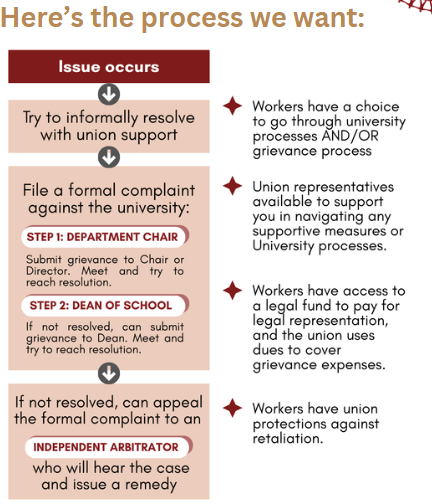
We feel that workers have the right to go through the Union grievance process and/or go through University processes, as they see fit for themselves.
We are demanding changes that better allow Union representatives to support you in navigating departmental, University-level, and independent arbitration processes. This is standard across other student worker contracts at Universities around the country, and for other Unions at Harvard, and we deserve to be on par with our peers!
CLARITY
We want clear definitions of harassment, discrimination, and bullying WITHIN our contract that Harvard cannot change at will (e.g., in its negotiations with the regressive policies of the Trump administration).
We also want explicit protections against retaliation for our speech as citizens, researchers, and educators. We should be able to protect ourselves and speak out against mistreatments in the workplace, without threats of retaliation from our supervisors and employers.
CARE
We are advocating for workers during the most vulnerable periods in their lives. Workers should not be punished for trying to secure safe and equitable working conditions.
We are asking for stronger rights for our disabled workers in need, including clear timelines on requests for accommodations, and the ability to receive full access to benefits and healthcare if placed on involuntary leave.
We are also asking for a lab transition program that provides 6 months of funding if workers need to leave their labs due to bullying or harassment.
Here is what we have versus what we NEED:
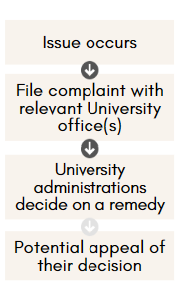
LEFT: the current processes, and what Harvard wants us to keep using. Trust is low in University processes: in 2019, one of Harvard’s Title IX coordinators told a worker that reporting to the press would have more impact that participating in Harvard’s internal process. We need better.
RIGHT: the system that we have proposed, and that Harvard has struck down many times during current negotiations. We deserve a fair system that includes 3rd-party representation and access to communal support.
Why does this matter? Hear from members below!
“Near the beginning of my PhD, I had a complicated relationship with another student in my department that broke down into a situation that involved manipulation, sexual harassment, and social isolation. I was upset at the time, but I believed the way this other person behaved was unique to our relationship. About a year later, I discovered that this same individual had harassed and manipulated someone else. This discovery revealed a pattern in this individual’s behavior, and it became clear to me that this person was a threat to others. Though I felt the intervening time had allowed me to largely recover from what I went through and I was reluctant to revisit what had been a difficult time for me, I went to the Title IX office in an effort to alert them to a dangerous person and to protect others who were at risk… However, I still had complicated feelings about what had happened to me. I was uncertain about what parts of my interactions with this person really qualified as harassment and about whether I had somehow invited this behavior from this person through our previous relationship. While these complicated feelings are not uncommon…, it was difficult to navigate the university process on my own and to try and explain to them what I wanted from contacting the Title IX office in the first place.
“What I wanted was to prevent this person from harming other people, but it’s difficult when you’re doubting yourself and your role in a case of sexual harassment to also navigate a confusing process and to stick to your conviction… I met with several Title IX representatives regarding my concerns, but I was repeatedly told I didn’t have a good Title IX case because I had a previous relationship with my harasser and because I was not assaulted. Though they suggested I could get help from CAMHS, there was no action taken to address my concerns or protect future victims… The person who harassed me did end up assaulting someone else about a year after I went to the Title IX office. If the university had acted on my concerns when I brought them, they could have prevented an assault. The way that the university failed me and the other members of my department in this process is incredibly frustrating… If I had had union representation to support me as I navigated the process, I believe I could have stood up for myself better, [which] could have led to changes that addressed my concerns. The Title IX process as it exists did not work for me, it did not protect the other members of my department despite my best efforts, and it has failed many other people as well. It needs to change.”
— Anonymous student worker
“When I told my advisor about the ongoing sexual harassment I had been experiencing in lab, he told my accusers I had tried to report them and then effectively fired me by refusing to sign my advising agreement. I spent an entire summer writing proposals, essentially reapplying to different advisors and different universities until a dean was able to hear my side of the story and helped me find funding. I’m still expected to work side by side with my harassers, whose behavior has not improved. In exchange for this funding, I have to teach, which was not the case before I was thrown out of my previous lab, and which I am not additionally compensated for, all the while my graduation timeline has greatly contracted. During this entire process, Title IX and department staff ignored my emails and pleas for accommodations. Faculty in my department expressed that they felt the situation was unfair but did not know what to do. Even though my continued work in a lab is now funded, my day to day remains extremely tough. I feel that I am continuing to put myself at risk by going in to lab, but I have no other choice. Harvard has done nothing to mitigate this situation. In fact, throughout the entire process, the union was the only organization that provided meaningful support. We need to add protections against harassment, discriminations retaliation to our contract to ensure that this doesn’t happen again.”
— Claire, student worker in SEAS
